Corjuem Fort, Military fort in Aldona, India
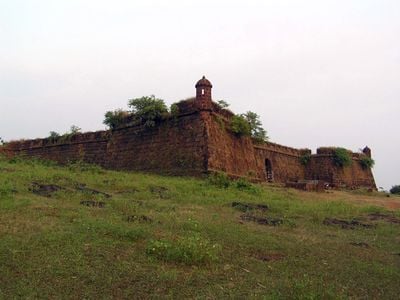
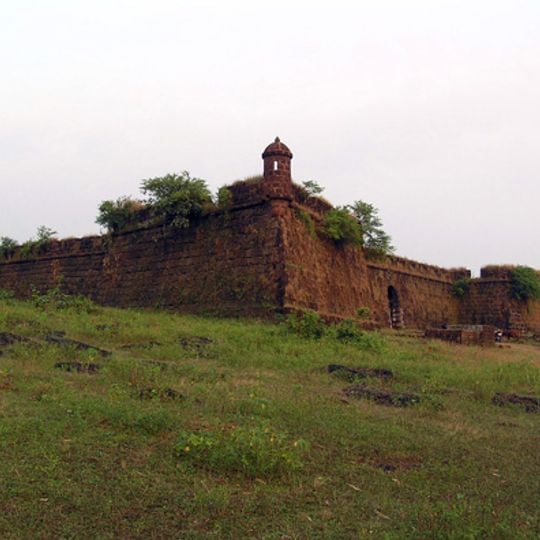
Corjuem Fort is a small laterite fortress on the river island of Corjuem in Bardez, Goa, one of only two surviving inland forts in the state built of pitted laterite. Its long defensive wall of large rough-cut brown stone has a sloping outer face and runs to a corner where it angles back; a small square watchtower with a domed roof and an open arched window sits on the highest section, and a lower wall on the right holds a single arched doorway. Weeds and shrubs grow along the top of the stonework.
Portuguese governor Caetano de Melo e Castro ordered the construction of this fortress in 1705 as a defensive measure against Maratha forces and to maintain control over river passage. It served as a key post in the Portuguese colonial strategy in the region.
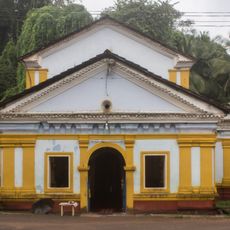
At the fort's entrance stands a shrine to Saint Anthony of Lisbon, installed by Adv. Ferreira and owned by the Parish of Aldona, which keeps it renovated. For almost 200 years villagers have walked from the Mae de Deus chapel to this altar in years of poor rainfall, praying for rain; the practice was last recorded in 2026.
Corjuem Fort stands on the river island of Corjuem in Bardez, about 4 km from Aldona and 12 km from Panjim, reached via the road bridge to the island. The laterite walls and the small domed watchtower are outdoors, so the surface is uneven and there is little shade; wear firm footwear. The shrine of St. Anthony stands at the entrance within the walls.
A Portuguese woman named Ursula e Lancastre served as a hidden soldier at this fort, disguised as a man, until she revealed her true identity when she decided to marry. This unusual story reflects a rare chapter in the fort's military history.
The community of curious travelers
AroundUs brings together thousands of curated places, local tips, and hidden gems, enriched daily by 93,132 contributors worldwide.