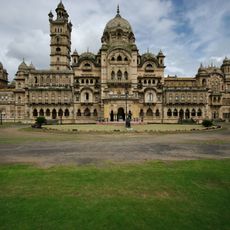
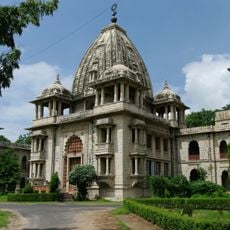
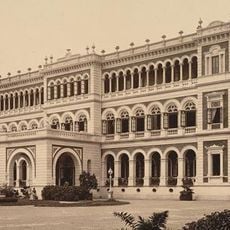
Nazarbaug Palace, Italian-Renaissance palace in Vadodara, India.
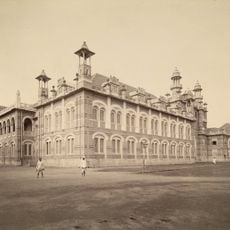
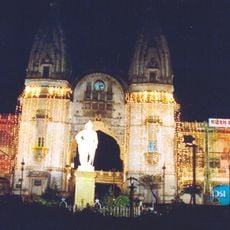
Nazarbaug Palace was an Italian-Renaissance building in Vadodara featuring four levels that decreased in floor size as they rose. This stepped design created a series of verandas and balconies that articulated the exterior walls of the structure.
Malhar Rao Gaekwad built the palace in 1871, and it is considered the oldest palace in Baroda. In its later years it served as a treasury and remained the royal family's first choice for large ceremonies, including the coronation of Sir Sayajirao Gaekwad III. It was razed in October 2014.
The palace's name comes from the Gujarati phrase 'Nazar Na Laage', meaning 'may it be protected from the evil eye', joined to 'baug', garden, for its grounds. It was still the royal family's first choice for large ceremonies, including the coronation of Sir Sayajirao Gaekwad III.
The original building was demolished in October 2014 and no longer exists in its former state. A modern shopping center now occupies the site in central Vadodara where the palace once stood.
The Pearl Carpet of Baroda, part of the Gaekwad treasury, was set with diamonds and seed pearls and meant as an offering to the tomb of the prophet Muhammad. In 1927 the palace jewels were valued at $10,000,000, a necklace in the collection carrying both the Star of the South, about 125 carats, and the English Dresden.
The community of curious travelers
AroundUs brings together thousands of curated places, local tips, and hidden gems, enriched daily by 93,011 contributors worldwide.