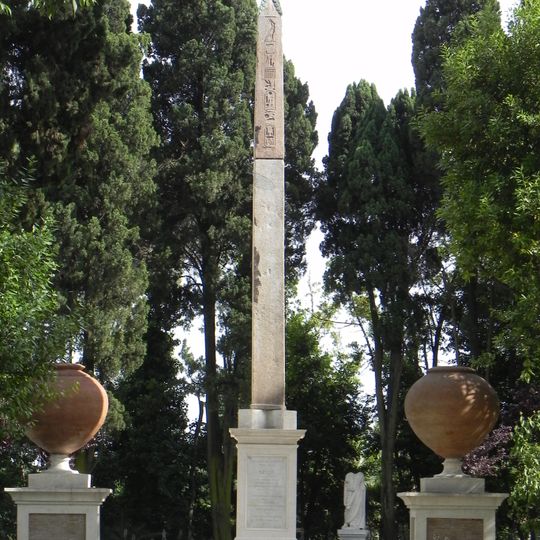
Matteiano obelisk, Egyptian obelisk in Villa Celimontana, Rome, Italy
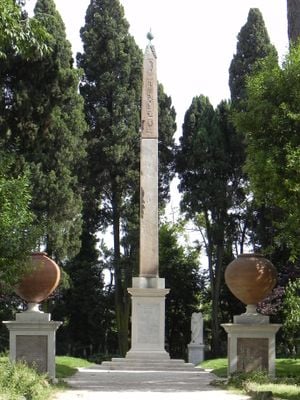
The Matteiano obelisk is an Egyptian monument located within Villa Celimontana, a public garden on Celio hill, bearing ancient inscriptions on its granite surface. The stone stands roughly 2.70 meters tall and sits among pathways and vegetation within the garden's baroque layout.
The obelisk is the twin of the one before the Pantheon, erected by Ramses II at Heliopolis between 1279 and 1213 BC and brought to Rome for the Iseum Campense. It stood on the Capitoline near Santa Maria in Aracoeli from at least 1407, was taken down in 1542, and in 1582 the Senate gave it to Ciriaco Mattei, who re-erected it in his Caelian garden on 11 September 1587. After the villa declined and the obelisk fell again, Manuel de Godoy had it set up in 1817 or 1820 at its present spot, completed with a cut granite block.
The obelisk sits within Villa Celimontana and is often passed by visitors without notice, yet it represents a direct connection to the ancient world. Its inscriptions and placement in the garden reflect how Rome absorbed and displayed objects from distant lands.
The obelisk stands in the gardens of Villa Celimontana on the Caelian Hill, reachable on foot from the Colosseum area. The grounds are open to the public, and the monument is found along the garden paths; the upper half is the original Ramses II granite, the lower part a modern granite block added after it fell.
The obelisk was physically altered in the early 19th century to restore its lost height, making it a deliberate reconstruction combining two different periods. This restoration demonstrates how Rome actively preserved and adapted its treasured objects.
The community of curious travelers
AroundUs brings together thousands of curated places, local tips, and hidden gems, enriched daily by 93,391 contributors worldwide.