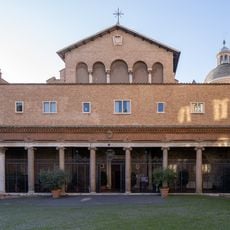
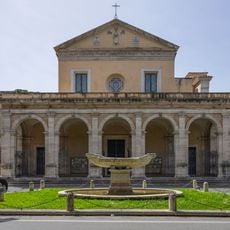
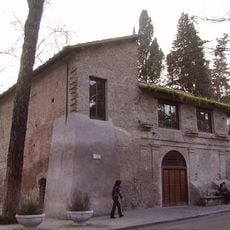
San Tommaso in Formis, Catholic church on Caelian Hill, Rome, Italy.
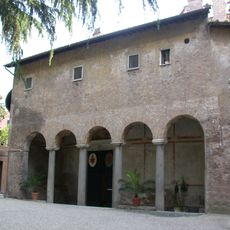
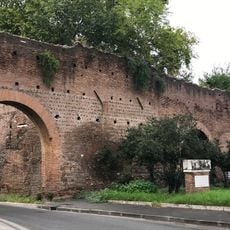
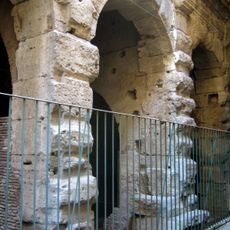
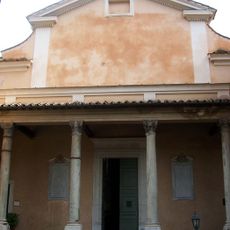
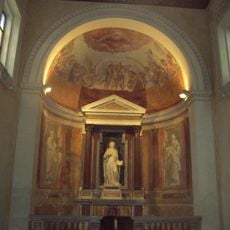
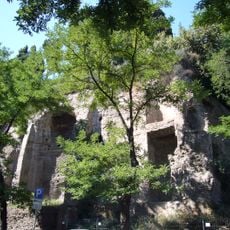
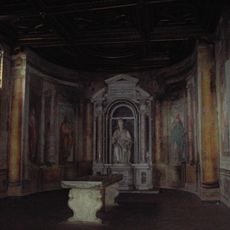
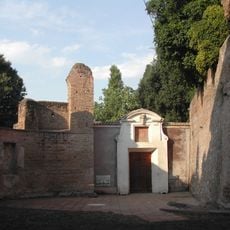
San Tommaso in Formis is a small single-nave church on the Caelian Hill, built into the side of the Claudian Aqueduct, from which its name in formis derives. Its northeast façade has a Romanesque portal with a 13th-century cosmatesque mosaic of Christ freeing two slaves, the seal of the Trinitarian Order. The interior is bare, lit by seven stained-glass windows made by Samuele Pulcini for the Jubilee of 2000.
Pope Innocent III transferred the church to the Trinitarian Order in 1209, a monastic community dedicated to helping freed slaves. This decision established its purpose as a center of religious mercy in the city.
The mosaic over the Romanesque entrance, made by Lorenzo Cosmati in the 13th century, shows Christ between two freed slaves and carries the seal of the Trinitarian Order. The Order was founded to ransom Christians held captive during the Crusades, and the image states that mission at the door.
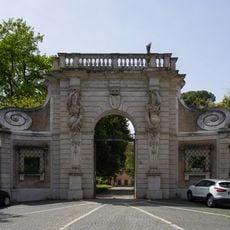
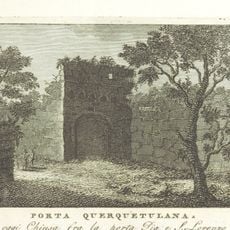
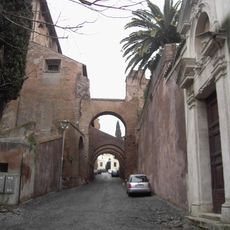
The church stands on Via San Paolo della Croce at the edge of Villa Celimontana, beside the Arch of Dolabella, which served as the Porta Caelimontana gate of the Servian Wall. The Trinitarian friars still serve it, so visits fit around their celebrations. The 13th-century mosaic portal with the cosmatesque Christ freeing two slaves faces the largo della Sanità militare, next to the former hospital's own portal.
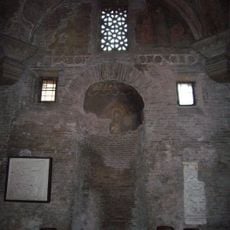
The two small rooms where Saint John of Matha died in 1213 were carved between the arches of the Claudian Aqueduct. In 1825 Don Emanuele Godoy, Prince of Bassano, ceded them to the Vatican Chapter, and they remain part of the church complex today.
The community of curious travelers
AroundUs brings together thousands of curated places, local tips, and hidden gems, enriched daily by 93,129 contributors worldwide.