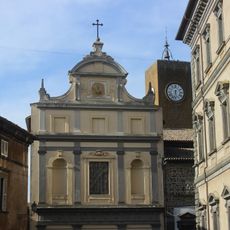
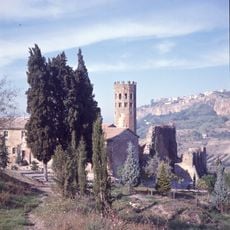
Sant'Andrea, Romanesque church in Orvieto, Italy
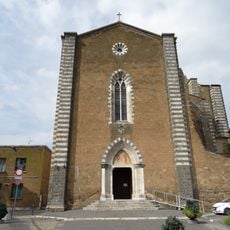
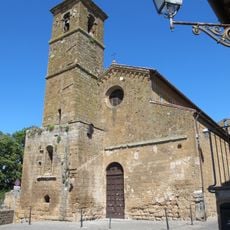
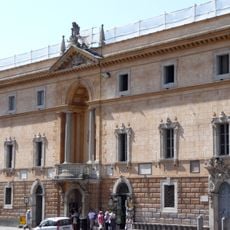
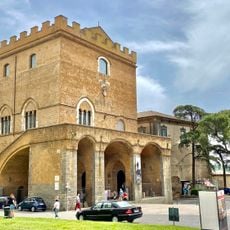
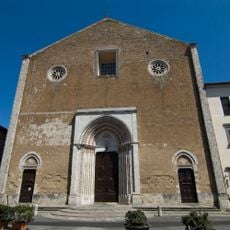
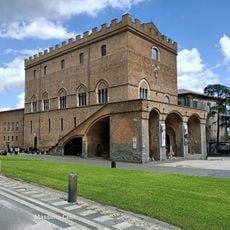
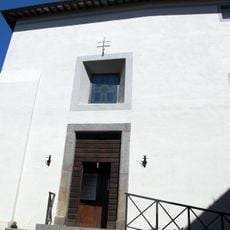
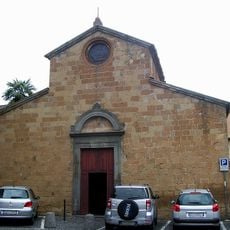
Sant'Andrea is a church on Piazza della Repubblica in Orvieto, built between the 11th and 12th centuries with a Latin-cross plan, three naves divided by eight monolithic columns of 2nd-century eastern granite, a double transept and a square apse. Its decagonal bell tower, with three orders of Lombard-style biforas, stands beside the Mannerist Palazzo Comunale.
The present building took shape between the 11th and 12th centuries, when the paleo-Christian church was modified starting from the apse and a double transept of round arches was added. The square apse was rebuilt in the 15th century, and Vito di Marco da Siena made the rose window and red marble portal in the 1400s. Gustavo Giovannoni restored church and tower between 1926 and 1930.
The church was originally dedicated to the apostles Andrew and Bartholomew and was reconsecrated in 1013 by Pope Benedict VIII. Pope Innocent III proclaimed the Fourth Crusade here in 1201, and Saint Peter Parenzo, Orvieto's first podestà, was canonized here in 1217. On 23 March 1281 Martin IV was crowned pope in the church in the presence of Charles I of Anjou.
Visitors can enter the church freely and admire the interior architecture. For exploring the archaeological area beneath the church, it is best to seek information beforehand, as access to this section is limited.
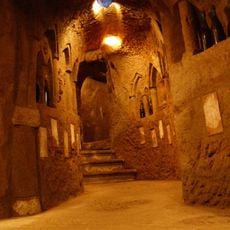
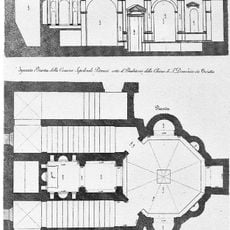
The octagonal font in the crypt is not the only ancient object there: the underground rooms display floor mosaics from the 6th century, bronze and ceramic items from the Bronze Age, and a stone carved with a Christian cross. A four-section museum route traces the site from the Bronze Age through the Etruscan era, when Orvieto was called Velzna, to Roman and Christian times.
The community of curious travelers
AroundUs brings together thousands of curated places, local tips, and hidden gems, enriched daily by 94,356 contributors worldwide.