Orvieto Cathedral, Gothic Catholic cathedral in Orvieto, Italy
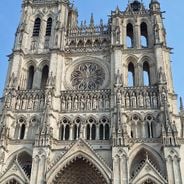
Orvieto Cathedral is a Gothic basilica in Orvieto, Italy, whose exterior walls carry wide stripes of black basalt and yellow limestone. The west facade shows a large rose window above the central portal, surrounded by golden mosaics and slender columns that rise to the gable.
Construction began in 1290 under Pope Nicholas IV after the city wanted to create a place for the relic from Bolsena. Lorenzo Maitani took over the design of the west facade in the early 14th century and continued the project over several decades.
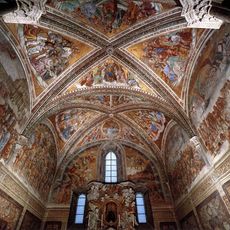
The cathedral is the seat of the Diocese of Orvieto-Todi, which absorbed Todi's former diocese in 1986. Its name recalls the two churches it replaced on the square, Santa Maria and San Costanzo. The Chapel of San Brizio, called the New Chapel, holds frescoes begun in 1447 by Beato Angelico and Benozzo Gozzoli and finished in 1499-1504 by Luca Signorelli.
The cathedral stands on the edge of the volcanic plug above the town, so the west facade and its three bronze portals face the open square. The interior has a wooden truss ceiling over three aisles; the Chapel of San Brizio opens off the right transept and the Chapel of the Corporal off the left. The five Renaissance bells are tuned in E flat.
The relic is kept in a tabernacle made in 1358–1363 by Nicola da Siena, probably with Orcagna. The chapel walls were frescoed in 1357–1364 by Ugolino di Prete Ilario, the only artist to sign the cycle. The cloth came from the Mass of a Bohemian priest, Peter of Prague, who doubted transubstantiation.
The community of curious travelers
AroundUs brings together thousands of curated places, local tips, and hidden gems, enriched daily by 92,653 contributors worldwide.