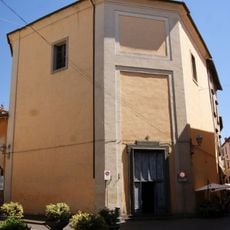
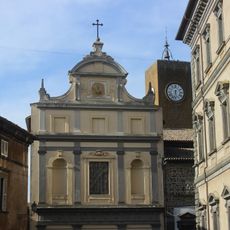
Palazzi rinascimentali di Orvieto, Renaissance palaces in Orvieto, Italy
The Renaissance palaces of Orvieto are a group of separate residences spread along Corso Cavour and the surrounding streets, not a single building. Palazzo Buzi, built by Ippolito Scalza around 1580, shows a late-Mannerist facade; Palazzo Carvajal-Simoncelli has a basalt front and a Spanish inscription band; Palazzo Clementini, begun by Scalza in 1567, stayed unfinished until 1937. Palazzo Bisenzi was remade by the Albani family in the 16th century and later turned into a hotel.
The Renaissance palaces of Orvieto were mostly built or remodelled between the 15th and 16th centuries. Palazzo Buzi was erected by Ippolito Scalza around 1580, Palazzo Clementini begun by him in 1567 and finished only in 1937 under Gustavo Giovannoni, and Palazzo Crispo-Marsciano designed by Antonio da Sangallo the Younger for Tiberio Crispo, then completed by Simone Mosca. Palazzo Carvajal-Simoncelli, also by Scalza, was commissioned in the first half of the 16th century by Cardinal Bernardino López de Carvajal.
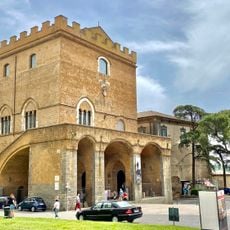
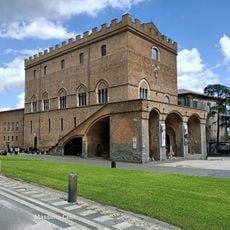
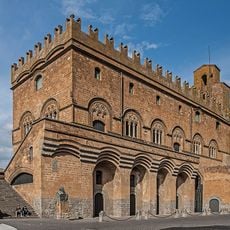
The name Palazzo dei Sette comes from the college of the Seven that owned it; in 1515 Leo X gave the buildings known as the tower of the pope and the Houses of Santa Chiesa to the comune. At the corner with Via della Costituente a plaque carries a tercet from Dante's Purgatorio naming the Monaldeschi and Filippeschi alongside the Montecchi and Capuleti. It now houses a cultural centre.
The palaces are scattered along Corso Cavour and the side streets of the old centre, so they are seen from outside while walking between Piazza della Repubblica and the Duomo. Palazzo Clementini in Piazza Ippolito Scalza houses Orvieto's classical lyceum, and Palazzo Febei is occupied by a bank, so interiors are not visitable as museums.
Palazzo dei Sette, beside the Torre del Moro, passed from the Della Terza family to the pope, then to the college of the Sette; in 1515 Leo X gave the buildings known as the torre del papa and Case di Santa Chiesa to the comune. At the corner with Via della Costituente a plaque carries a tercet from Dante's Purgatorio naming the Monaldeschi and Filippeschi alongside the Montecchi and Capuleti.
The community of curious travelers
AroundUs brings together thousands of curated places, local tips, and hidden gems, enriched daily by 94,528 contributors worldwide.