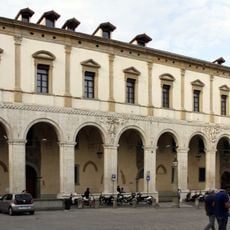
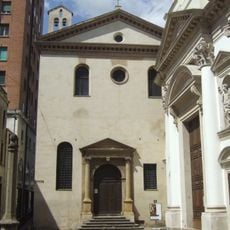
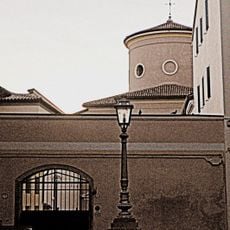
Padua Baptistery, Baptistery in Padua, Italy
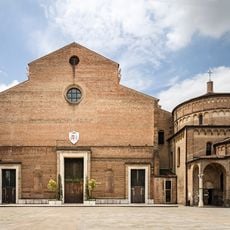
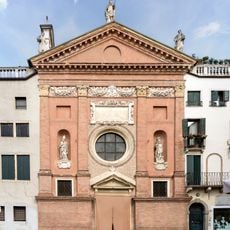
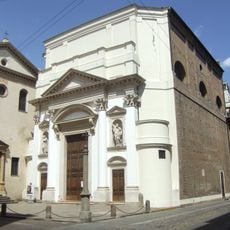
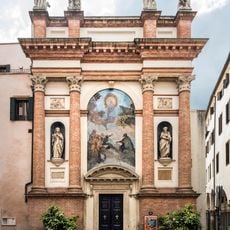
The Padua Baptistery is a Romanesque building next to the cathedral on Piazza del Duomo, with a plain exterior and a dome. Inside, Giusto de' Menabuoi's frescoes of 1375–1376 cover the walls and cupola: a Christ Pantocrator at the centre of Paradise, Genesis scenes in the tholobate, and the life of John the Baptist to the left of the entrance.
Construction began in the 12th century, possibly over an earlier structure, and the baptistery was consecrated in 1281 by Guido, patriarch of Grado. Between 1370 and 1379 it was restored and adapted as the mausoleum of Francesco il Vecchio da Carrara and his wife Fina Buzzaccarini, who commissioned Giusto de' Menabuoi's decoration. After the fall of the Da Carrara in 1405, Venetian soldiers demolished the tombs and covered Francesco's emblems with green paint.
The frescoes were painted in 1375–1376, not the 1370s generally: Giusto de' Menabuoi placed members of the Carrara court among the New Testament crowds, and the donor Fina Buzzaccarini appears with her daughters in the Birth of John the Baptist and in a lunette where the Baptist entrusts her to the Virgin. The cupola shows Paradise around a Christ Pantocrator, with the Virgin in a blue mantle on the same axis.
The building is easy to locate since it stands directly beside the Cathedral in the main square of the city. Plan your visit in advance, as access depends on specific hours and may be limited due to the nature of the religious space.
In the Creation scene on the tholobate, Giusto de' Menabuoi painted the zodiac to show Christ as lord of cosmic time, a reference to the three hours of darkness at the Crucifixion. The same cycle places members of the da Carrara court among the New Testament crowds, and Fina Buzzaccarini appears with her daughters in the Birth of John the Baptist.
The community of curious travelers
AroundUs brings together thousands of curated places, local tips, and hidden gems, enriched daily by 92,743 contributors worldwide.