Forte Santa Caterina, Fort in Verona, Italy
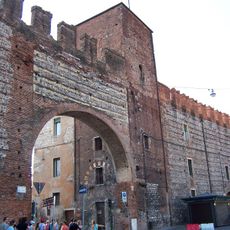
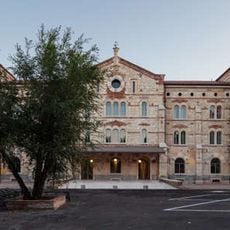
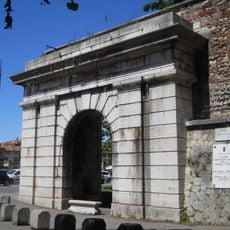
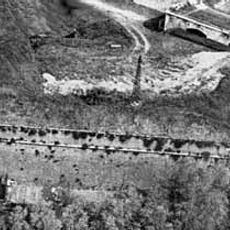
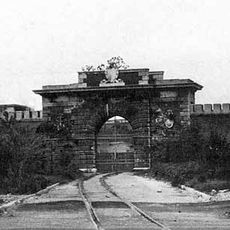
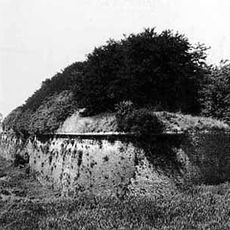
Forte Santa Caterina is a large polygonal fort with a symmetrical lunette plan, its flanks diverging toward the main front and ending in rounded shoulders at the perfectly straight gorge. Inside, dry security moats divide the work into four parts: the main rampart with gun positions and inner parade ground, two flanking caponiers, and the reduit. The gorge front facing the Adige had four arched, rusticated portals with a drawbridge.
Forte Santa Caterina was built between 1850 and 1852 under Conrad Petrasch, director of the Imperial Royal Office of Fortifications in Verona, following a cheaper single-fort design by Johann von Hlavaty derived from Franz von Scholl's 1834–1838 three-fort plan. It formed part of the first fortified plain field, laid out between 1848 and 1856. In 1866 it was still fully armed and operational.
The Italian name comes from a chapel of Saint Catherine of Siena that stood on the road from the San Pancrazio lazaretto to Porta Nuova. In 1850–1852 the fort was instead officially named Werk Hess after Baron Heinrich von Hess, artillery general and chief of staff under Radetzky, who signed the Salasco armistice.
The site is located on Via del Pestrino and is accessible to visitors who want to explore military architecture. Good paths and open spaces allow you to walk around and see the overall layout clearly.
During the 1970s, the site was converted into a motocross track, leaving visible changes that remain today. This unexpected transformation altered parts of the original structure and gives it an unusual history for a military fort.
The community of curious travelers
AroundUs brings together thousands of curated places, local tips, and hidden gems, enriched daily by 93,137 contributors worldwide.