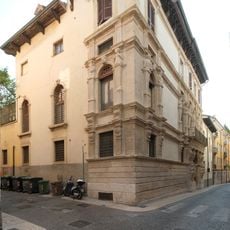
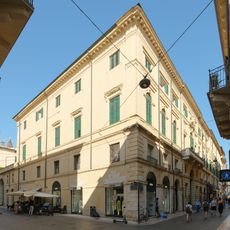
Palazzo Pompei, Renaissance palace in Verona, Italy.
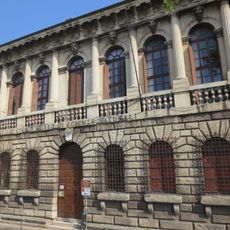
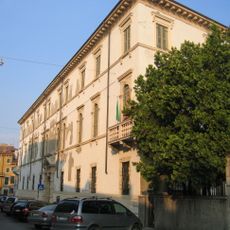
Palazzo Pompei is a Renaissance palace in central Verona, built with a rusticated stone ground floor and an upper level framed by eight fluted columns. Seven large windows run across the upper floor in a regular rhythm that gives the facade its measured, orderly appearance.
Michele Sanmicheli, one of the leading Renaissance architects of his time, designed the palace between 1530 and 1550 for the Lavezola family. The Pompei family acquired it in 1579 and the building has carried their name ever since.
The palace takes its name from the Pompei family, who bought it in 1579 and kept it for over two centuries. Alessandro Pompei, a scholar of Veronese neoclassical architecture, assembled two large tables of classified stones and marbles quarried near Verona; these were later dispersed. The family donated the building to the city in 1833, and their art collection, including a painting by Albrecht Dürer, went to Castelvecchio.
The palace sits in central Verona and is easy to reach on foot from the main sights. Access to the interior depends on current events or exhibitions, so it is worth checking in advance whether it is open to visitors on the day you plan to go.
The facade of Palazzo Pompei served as a model for Gottfried Semper's Dresden picture gallery (1847–1855) and for the two symmetrical wings of Vienna's Kunsthistorisches Museum and Naturhistorisches Museum. In 1754 Karl Ludwig Hildebrandt built a palace of the same name in Potsdam after this Veronese design; destroyed in 1945, it was rebuilt in 2016 using three surviving original mascheroni.
The community of curious travelers
AroundUs brings together thousands of curated places, local tips, and hidden gems, enriched daily by 93,009 contributors worldwide.