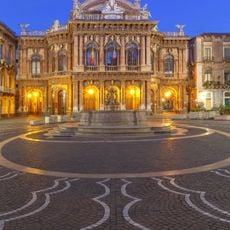
Fountain of Proserpina, Public fountain at Station Square, Catania, Italy.
The Fountain of Proserpina is a monumental fountain of 1904 by Giulio Moschetti, with his son Mario, set at the end of Via VI Aprile beside Catania's central station. Its irregular basin, unusually large for Sicily, is cast in raw cement, a cheap and plastic material then rare in public works. On a rocky rise stand Hades and Proserpina at the moment of the abduction, with sea horses and sirens modelled in smoothed cement around the foot.
The fountain was commissioned from Giulio Moschetti, working with his son Mario, to decorate the area around Catania's railway station, opened in 1867. The sculptural group was modelled in raw cement, a cheap and plastic material then little used for public works, and the fountain was restored in February 1999.
The fountain takes its name from the Roman goddess Proserpina, who was carried off to the underworld according to ancient myth. The carved figures around the basin tell this story in a way that anyone passing through the square can follow without prior knowledge.
The fountain stands freely in the square and can be approached from all sides; it is lit up in the evening. That is when the figures are easiest to see in detail, with the light playing across the carved surfaces.
Moschetti chose a Baroque model at a time when newer art movements were already changing the look of public spaces across Italy. The fountain is one of the few works in Catania that brings together a 17th-century source and a 20th-century hand in a single object.
The community of curious travelers
AroundUs brings together thousands of curated places, local tips, and hidden gems, enriched daily by 93,637 contributors worldwide.