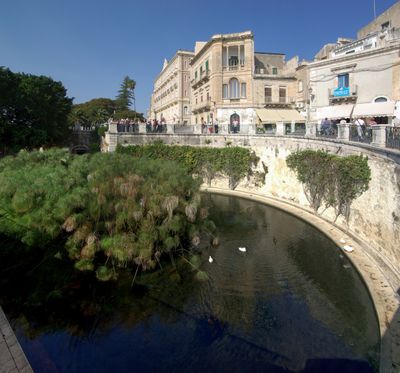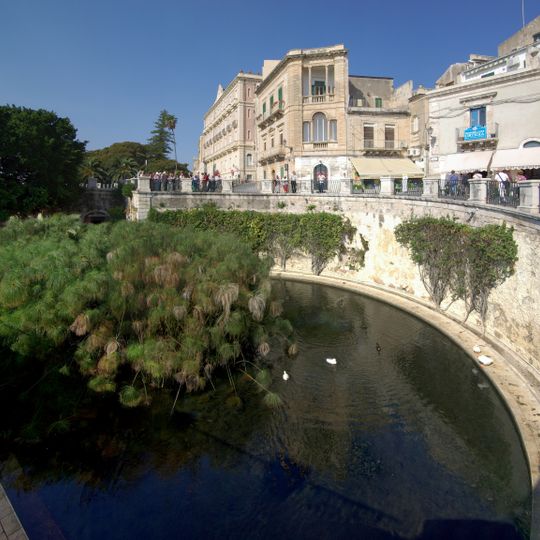
Source of Arethusa, Freshwater spring with lake in Ortigia, Syracuse, Italy
The fountain of Arethusa is a freshwater spring in Ortigia, Syracuse, Italy, that feeds a natural basin of clear water close to the Mediterranean shore. Grey mullet swim among the green papyrus stalks that grow directly from the shallow bottom.
The spring lay outside Syracuse's fortifications in antiquity, reachable from the sea by a steep stair and a gate the Romans reportedly used during the city's conquest. In the 16th century its water fed streams used for tanning hides, forming a lake about 200 metres across. In 1540 Charles V incorporated it into Ortigia's defences; it was freed in 1847, when the basin took its present form.
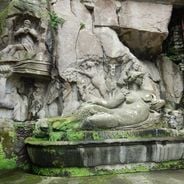
The name comes from a Greek tale in which the nymph Arethusa turned herself into freshwater to flow beneath the sea. Today visitors can see papyrus stalks growing from the shallow basin and lining the shore.
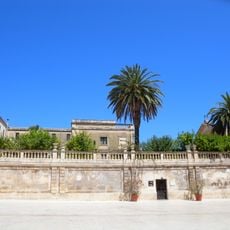
The basin sits directly beside the seafront promenade and is accessible at any time, with a low stone wall surrounding the water. The walk from the town center takes just a few minutes and the site is lit in the evening.
Papyrus grows in the pool itself, and the sources name three European sites for it: the spring, the Ciane river south of Syracuse and the Fiume Freddo in the province of Catania. Drought and possibly the building of the third bridge have reduced the spring's flow, threatening the plants.
The community of curious travelers
AroundUs brings together thousands of curated places, local tips, and hidden gems, enriched daily by 92,687 contributors worldwide.