Ancient Greek walls of Syracuse, Ancient defensive wall on the Epipoli plateau, Syracuse, Italy
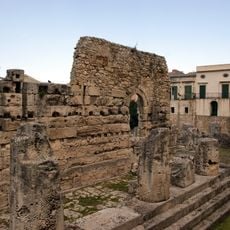
The ancient Greek walls of Syracuse are a limestone circuit built by Dionysius I from 402 to 397 BC, running 21 km around the Epipoli plateau and meeting at the Castello Eurialo. Their base is 3.3 to 5.35 m thick, with 14 known towers, the largest 8.5 by 8.5 m. Gates such as the Trypilon and Porta Scea are still legible in the northern sector.
Dionysius I built the walls between 402 and 397 BC to fortify the unfortified Epipoli plateau, enclosing the whole of Syracuse in a 21 km circuit that met at the Castello Eurialo. They withstood Carthage's siege in 397 BC and long hindered the Romans, who took the city in 212 BC. After Roman reinforcement, later rulers quarried the blocks for new buildings, and the 1693 earthquake brought them down; Paolo Orsi later rediscovered them.
The walls took their name from Dionysius I, who had them built; the Trypilon gate near Castello Eurialo and the Porta Scea at Scala Greca are still legible. A gate in Ortygia, in the excavation of via XX Settembre, linked Neapolis to the island fortress. In 2014 a ring-shaped park of the Dionysian walls was established to protect and open the circuit.
The walls run across the Epipoli plateau above the city, not around Ortygia; the circuit met at the Castello Eurialo, the highest point, where remains are most visible. Sections and gates such as the Trypilon near the castle and the Porta Scea at Scala Greca lie along the northern edge. A ring-shaped park of the walls was established in 2014, though its full layout still awaits funding.
According to Diodorus Siculus, 70,000 slaves and 6,000 oxen in teams of 200 built the circuit, filling 300 tonnes of blocks a day. The walls ran 21 km, or 27 km counting the section on Ortygia, and met at the highest point at Castello Eurialo. The archaeologist Paolo Orsi rediscovered them after the 1693 earthquake.
The community of curious travelers
AroundUs brings together thousands of curated places, local tips, and hidden gems, enriched daily by 92,935 contributors worldwide.