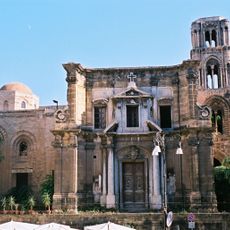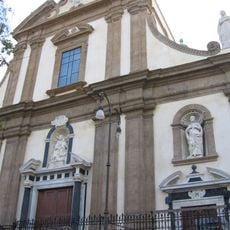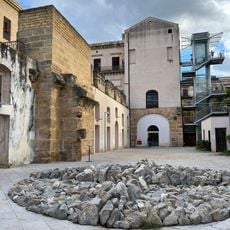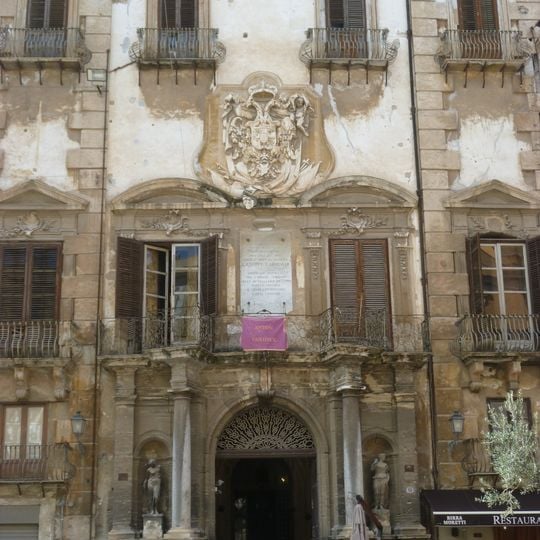
Palazzo Alliata di Villafranca, Noble palace in Piazza Bologni, Palermo, Italy.
Palazzo Alliata di Villafranca occupies a full block between the Cassaro and Via dell'Università, forming the fourth side of Piazza Bologni. Its stone facade has two symmetrical portals, recalling its role as seat of the Kingdom of Sicily's postal couriers, and two large stucco coats of arms by Giacomo Serpotta. Inside, the piano nobile includes the Salotto Verde with Van Dyck's 1625 Crucifixion and the Sala del Principe Fabrizio Alliata Colonna with two 1639 canvases by Matthias Stom.
The residence was built over the 17th and 18th centuries as a seat of the Alliata family and underwent major reconstruction following the 1751 earthquake under the direction of architect Giovanni Battista Vaccarini. These reconstruction efforts connected it with adjacent buildings and shaped its current form.
The palace served as a repository for important artworks and collections that reflected the tastes and status of the noble family who lived there. The rooms reveal how wealthy families decorated their homes and what artistic works held meaning for them.
Visitors can explore the palace's interior through guided visits available on several days throughout the week, though advance arrangements are recommended. The tour moves through multiple levels and shows the layout and furnishings typical of a noble residence.
The Alliata held the hereditary title of Grand Postmasters of the Kingdom of Sicily, and the ground-floor rooms built for the postal service still survive. A plaque on the facade records that Giuseppe Garibaldi stopped here on 27 May 1860, resting for just two hours during the Expedition of the Thousand.
The community of curious travelers
AroundUs brings together thousands of curated places, local tips, and hidden gems, enriched daily by 94,671 contributors worldwide.