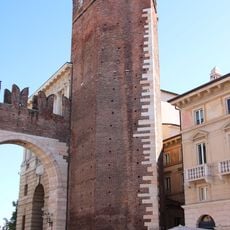
Carli Palace of Verona, Neoclassical palace in Verona, Italy
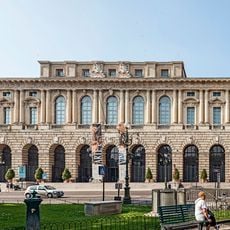
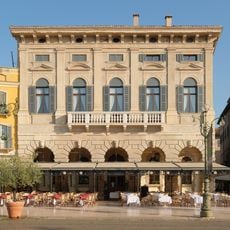
Carli Palace is a neoclassical building with three clearly distinct levels, rusticated arches, and Doric columns on the ground floor. A central hall with a loggia above forms the core of the structure and anchors the architectural composition.
Commissioned by Marquis Giuseppe Della Torre and his wife Elena Carli in the mid-18th century, the palace passed in 1780 to her brother Alessandro Carli, who had Gaetano Cignaroli sculpt the statue of Pallas Athena still in the atrium. Sold to the Basilea brothers in 1812, it was bought in 1839 by the Imperial Austrian authorities and housed the Supreme Court of Justice of the Kingdom of Lombardy–Venetia until 1851. Field Marshal Radetzky resided there from 1853, and on 16 October 1866 the act ceding Veneto to Italy was signed in the Sala degli Stucchi.
The name Carli comes from Elena Carli, wife of Marquis Giuseppe Della Torre, who commissioned the palace; her brother Alessandro later owned it and in 1780 had Gaetano Cignaroli make the statue of Pallas Athena still standing in the entrance hall. Inside, frescoes by Giambettino Cignaroli, Domenico Pecchio and Marco Marcola decorate several rooms.
The building currently serves as military headquarters and is not open to the public. Visitors can appreciate the exterior architecture and facade from the street.
The room where the handover was signed is called Sala degli Stucchi, after its stucco decoration. The act of 16 October 1866 transferred Verona and the Veneto to the Kingdom of Italy, and the palace had already served the Austrian administration as the seat of the Supreme Court of Justice for Lombardy-Venetia from 1839 to 1851.
The community of curious travelers
AroundUs brings together thousands of curated places, local tips, and hidden gems, enriched daily by 94,672 contributors worldwide.