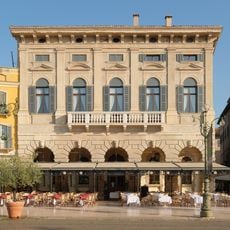
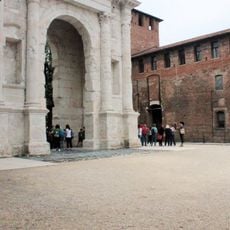
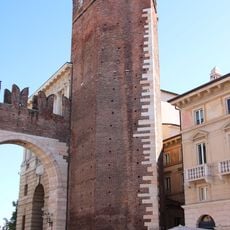
Palazzo Verità Poeta, Palace in Verona, Italy
Palazzo Verità Poeta is an 18th-century palace in Verona, built on a design attributed to Antonio Galli da Bibbiena. Its piano nobile is reached by a marble-dust staircase painted with illusionistic views and trompe-l'œil. There the Salone delle Feste, over 100 square metres, connects to six other rooms with frescoed walls and period furniture, and a garden of over 1,000 square metres is reached by a scenic "alla romana" staircase.
The palace was built and decorated in the 18th century, probably to a design by Antonio Galli da Bibbiena, a scenographer who planned theatres across Europe. Filippo Maccari, Francesco Lorenzi and Lorenzo Pavia worked on the interiors; Pavia died in December 1764, shortly after finishing his decorations, which dates the completion of the works. The building was declared of notable historical and artistic interest in 1939.
The palace takes its name from the Veronese Verità Poeta family, whose lineage is intertwined with the city's history. Above the doors of the Salone delle Feste hang portraits of the artists who decorated it, among them Filippo Maccari, Francesco Lorenzi and Lorenzo Pavia.
The main floor is reached by a marble-effect staircase painted with illusionistic views and trompe-l'œil, leading to the Salone delle Feste and six adjoining frescoed rooms. A garden of over 1,000 m² lies beyond, reached by a scenographic "alla romana" staircase. The building was listed by the local Soprintendenza in 1939.
The ceiling fresco of the Salone delle Feste was drawn with perspectival calculations on the proportions of the room, so that each painted column appears correct from any point in the hall. Lorenzo Pavia died in December 1764, shortly after finishing the decorations entrusted to him, which dates the completion of the works.
The community of curious travelers
AroundUs brings together thousands of curated places, local tips, and hidden gems, enriched daily by 94,579 contributors worldwide.