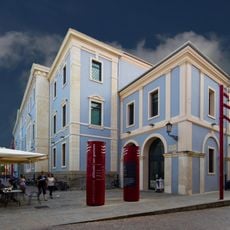
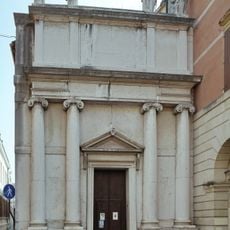
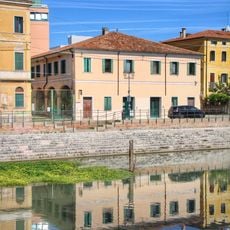
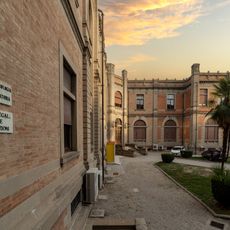
Porta Ognissanti, City gate at Via del Portello, Padua, Italy.
Porta Ognissanti is a city gate spanning the Piovego canal that connects Padua's center with surrounding areas. Built from white Istrian marble with eight columns rising from the water and a clock tower at its top, the structure features three arches designed for vehicle and foot traffic.
Porta Ognissanti was built in 1519 to replace the older Portello Vecchio gate, which stood on today's Via San Massimo. It was erected as part of the sixteenth-century walls of Padua raised by the Republic of Venice, on a design by the architect Guglielmo de' Grigi, known as il Bergamasco. It stood at the terminus of the main water route linking Padua to Venice along the Riviera del Brenta.
The gate's name comes from the Latin Omnium Sanctorum, and it is also called Portello Nuovo or Porta Venezia. The Portello district was the arrival point for boats linking Padua to Venice along the Riviera del Brenta. Canaletto painted the gate in 1760; the painting is now at the Thyssen-Bornemisza Museum in Madrid.
The gate serves as a working crossing point for vehicles and pedestrians traversing the canal, making it an active part of the city's daily movement. The structure is easy to locate from Via del Portello and offers clear passage with good visibility from all directions.
The Marcian lion relief that once adorned the gate was torn off by French soldiers after the fall of Venice in 1797 and thrown into the adjacent canal. Retrieved and auctioned, it was bought by the Assicurazioni Generali, which had adopted it as its company symbol; it is now set into the facade of the Generali building in Rome, facing Palazzo Venezia.
The community of curious travelers
AroundUs brings together thousands of curated places, local tips, and hidden gems, enriched daily by 94,408 contributors worldwide.