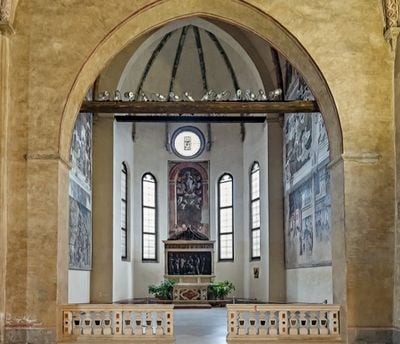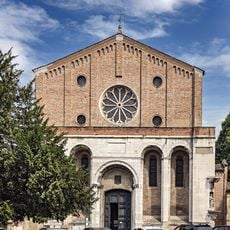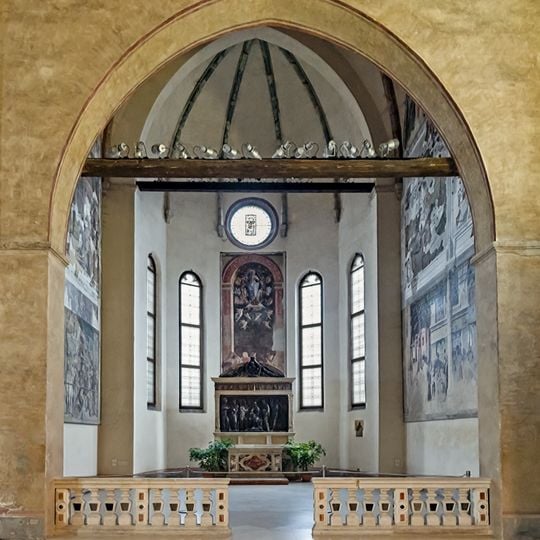
Ovetari Chapel, Renaissance chapel in Church of the Eremitani, Padua, Italy
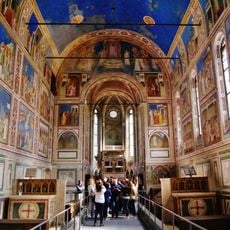
The Ovetari Chapel in the Church of the Eremitani in Padua presents wall paintings showing scenes from the lives of Christopher and James arranged across three stacked sections. The parts visible today give an impression of the original layout and the spatial depth that the artists developed.
The notary Antonio Ovetari left a large sum for the family chapel, and in 1448 his widow Imperatrice hired Giovanni d'Alemagna, Antonio Vivarini, Niccolò Pizzolo and the seventeen-year-old Andrea Mantegna. Work ran from 1448 to 1457, with Mantegna finishing alone after Pizzolo's death in 1453. An Allied bombing on 11 March 1944 destroyed the frescoes; two scenes detached around 1880 had been stored elsewhere, and the surviving fragments were reassembled in a restoration completed in 2006.
The stories of the two saints show scenes from their lives and deaths as they were honored in the late medieval period. Visitors today can trace the composition and use of color that were considered a new way of arranging images at the time.
The chapel sits in the right transept of the church and is accessible during the building's opening hours. Visitors should allow some time to look at the preserved fragments and the information about the reconstruction after the war damage.
The chapel was dedicated to Saints James and Christopher, and the arch carried two large heads usually identified as self-portraits by Mantegna and Pizzolo. The two scenes detached around 1880, the Assumption and the Martyrdom of Saint Christopher, survived the 1944 raid only because they had been stored elsewhere.
The community of curious travelers
AroundUs brings together thousands of curated places, local tips, and hidden gems, enriched daily by 93,841 contributors worldwide.