Scurati Caves, Prehistoric cave complex in Custonaci, Italy
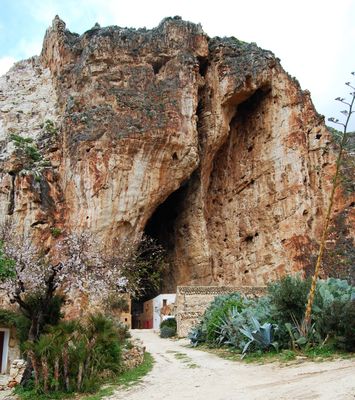
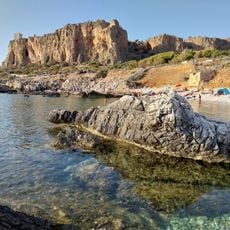
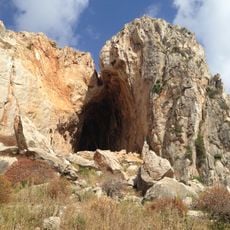
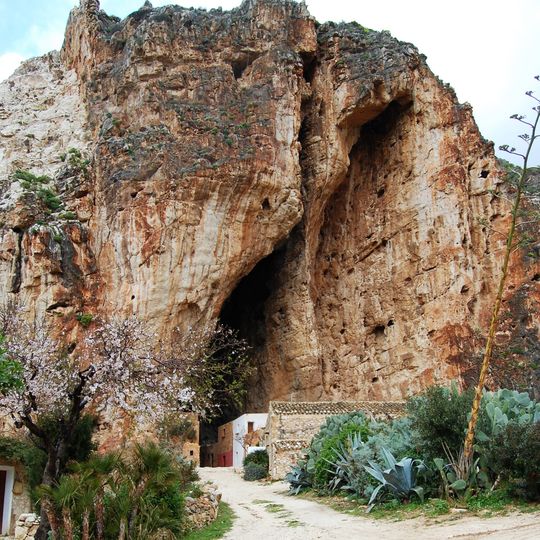
The Scurati Caves are a group of nine caves in the Custonaci area, some inside the Monte Cofano nature reserve. The largest, Grotta Mangiapane, also called Grotta degli Uffizi, opens in a sheer reddish-brown rock face and measures about 70 metres high, 13 wide and 50 deep. A low stone wall and a small white-walled building stand at its base.
The cave system served as a shelter for early humans in prehistoric times, who left traces of their presence within its walls. In more recent centuries, starting from 1819, the largest cave became a permanent home where families built a small village that lasted until the mid-twentieth century.
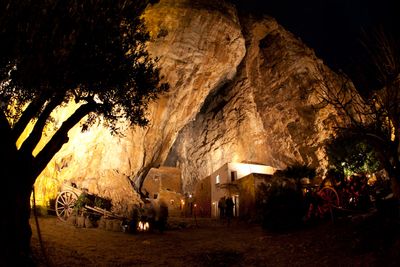
The name Mangiapane, used for the largest cave, comes from the family that lived there until the 1950s. Since 1983 the cave has hosted the Presepe vivente di Custonaci, a living nativity with about 160 participants reviving local farming and craft traditions; in 2006 it entered Sicily's Register of Intangible Heritage. The Montalbano episode Il ladro di merendine was filmed here.
The site lies near the Scurati hamlet of Custonaci, in the province of Trapani, and part of the caves fall within the Monte Cofano oriented nature reserve. The Mangiapane cave, about 70 m high, 13 m wide and 50 m deep, opens at the foot of a sheer reddish-brown cliff beside a low stone wall and a small white-walled building. Ground near the entrances is uneven, with sparse trees and plants at the base.
The village inside the Mangiapane cave is not a reconstruction: families lived in the houses from 1819 until the 1950s, and the cave belonged to the Mangiapane family. The 2004 excavations there brought to light early and middle Neolithic pottery. The cave is also called Grotta degli Uffizi.
The community of curious travelers
AroundUs brings together thousands of curated places, local tips, and hidden gems, enriched daily by 92,935 contributors worldwide.