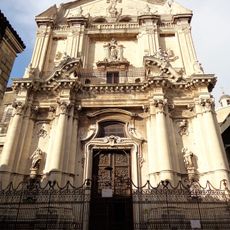
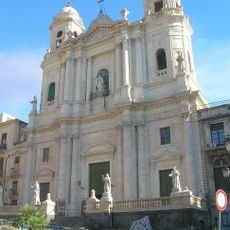
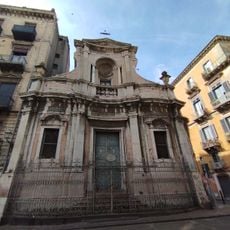
Santa Maria dell'aiuto, Sicilian Baroque shrine in central Catania, Italy.
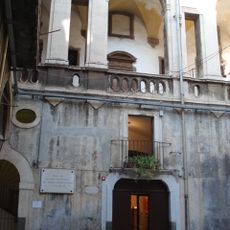
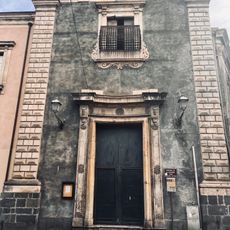
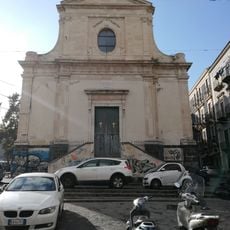
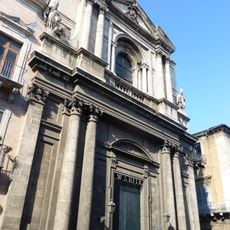
Santa Maria dell'Aiuto is a shrine in Sicilian Baroque style featuring a wide staircase ascending to a facade with modified Ionic columns and two tall stone columns topped with Corinthian capitals. Inside, the spaces combine colored marble and sculptures in a balanced composition typical of the local architectural tradition.
A small church of Saints Peter and Paul stood here before 1693; the cult of the Madonna dell'Aiuto had been attached to it since 1372, when a Byzantine-style icon was displayed outside. On 3 November 1641 the Marian congregation of Santa Marina carried that venerated image into the church in a solemn procession led by Bishop Ottavio Branciforte. The 1693 earthquake razed the building; it was rebuilt to a design by Antonino Battaglia, with decoration by Michele Orlando, and the facade and clock tower were completed in the 19th century.
The name comes from a Byzantine-style icon of the Virgin, called Madonna dell'Aiuto since 1372, moved here on 3 November 1641 from the church of Saints Simon and Jude. It survived the 1693 earthquake and stands above the polychrome marble high altar, framed by statues of Saints Peter and Paul and a marble group of God the Father with five angels.
The shrine stands at Via Santa Maria dell'Aiuto 80 at the intersection of several streets, making it easy to locate. Access is gained through the prominent front staircase that leads directly to the entrance.
The Loreto replica was placed in the church in the 1740s by canon Giuseppe Lauria as an act of devotion. It is a reduced-scale copy, a 18th-century reinterpretation of the Marche original made by several artists, not a life-size reproduction.
The community of curious travelers
AroundUs brings together thousands of curated places, local tips, and hidden gems, enriched daily by 94,162 contributors worldwide.