Sant'Eufemia, Catholic church in Ravenna, Italy
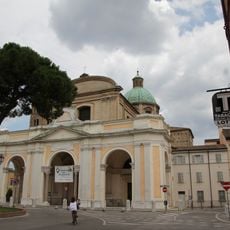
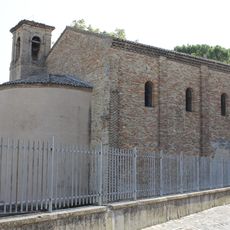
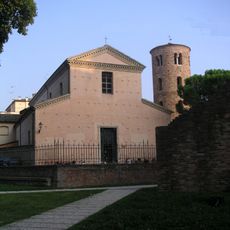
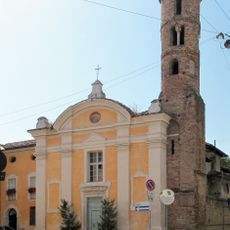
Sant'Eufemia is a centrally planned church on Via Barbiani, entered through a small green space enclosed by an iron gate erected in the early 1900s. Inside are three altars: the main altar, with the choir behind it holding Antonio Burrini's painting of the saint's death and, on the right, Andrea Barbiani's Saint Apollinaris baptizing the tribune; the left altar has Giovanni Capaci's Annunciation of 1747, the right one a Visitation. A small bell gable holds a bell dated 1358.
The church was designed by Giovan Francesco Buonamici, the architect of Ravenna Cathedral, and built on the foundations of an earlier three-nave paleochristian temple divided by two rows of six columns, whose construction date is unknown. According to legend, Ravenna's first place of worship stood here. In 1686 relics of Saints Euphemia and Agatha were found inside and placed in a small sarcophagus on the altar.
The dedication comes from the legend that Saint Apollinaris, travelling to Aquileia, obtained the body of the young Euphemia as a relic; a small well in the sacristy recalls it. In 1686 relics of Euphemia and Saint Agatha were found in the church and placed in a small sarcophagus on the altar.
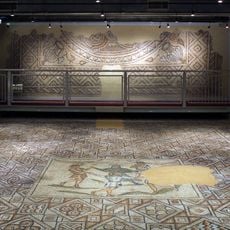
Since October 2002 the church has been the entrance to the Domus dei Tappeti di Pietra, an archaeological site 3 metres below street level behind the building. Access to the mosaics passes through the church itself, on Via Barbiani in the city centre.
In the sacristy a small well carries an inscription linking the church's dedication to Saint Euphemia: Saint Apollinaris, travelling to Aquileia, obtained the body of the young woman who had just died as a relic. The church also keeps a bell dated 1358 in its small bell tower.
The community of curious travelers
AroundUs brings together thousands of curated places, local tips, and hidden gems, enriched daily by 92,867 contributors worldwide.