Early Christian Monuments of Ravenna, Religious monuments in Ravenna, Italy
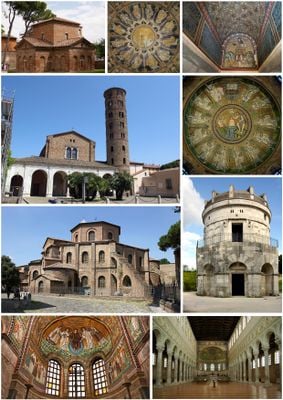
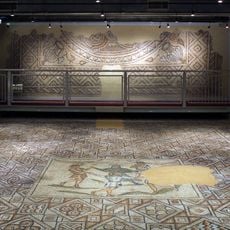
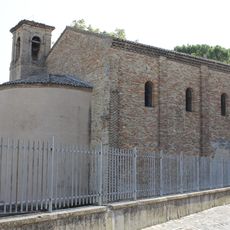
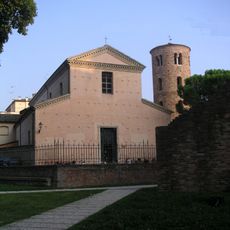
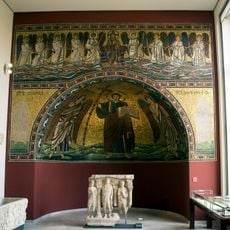
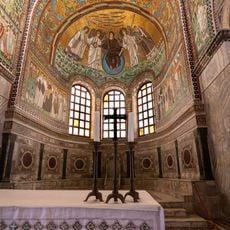
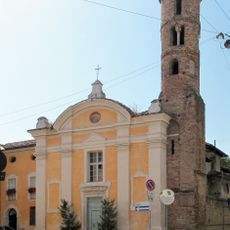
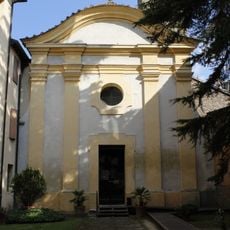
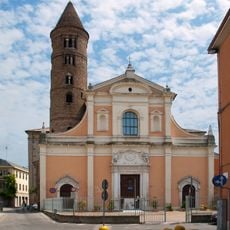
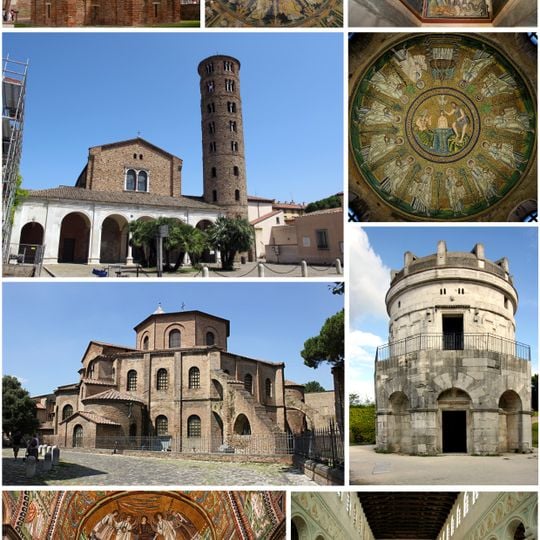
The Early Christian Monuments of Ravenna comprise eight buildings from the 5th and 6th centuries: the Mausoleum of Galla Placidia, the Neon Baptistery, the Arian Baptistery, the Archiepiscopal Chapel, the Basilica of Sant'Apollinare Nuovo, the Mausoleum of Theodoric, the Basilica of San Vitale and the Basilica of Sant'Apollinare in Classe. They include a tall cylindrical brick tower, an octagonal brick baptistery with a tiled roof, and interiors covered in mosaics.
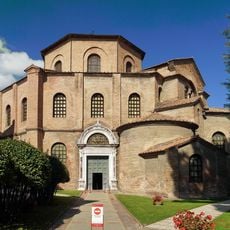
The eight monuments date from the 5th and 6th centuries. In 402 Emperor Honorius moved the Western Roman capital from Milan to Ravenna; the Mausoleum of Galla Placidia and the Neon Baptistery belong to that first half of the 5th century. Under the Ostrogoth Theodoric, king from 493, Ravenna became a kingdom's capital and gained the Arian Baptistery, the Archiepiscopal Chapel, Sant'Apollinare Nuovo and his mausoleum. After Belisarius took the city in 540, Justinian made it capital of the Exarchate and Archbishop Maximian inaugurated San Vitale and Sant'Apollinare in Classe.
The site comprises eight monuments, not five: the Mausoleum of Galla Placidia, the Neon Baptistery, the Arian Baptistery, the Archiepiscopal Chapel, Sant'Apollinare Nuovo, the Mausoleum of Theodoric, San Vitale and Sant'Apollinare in Classe. The Arian Baptistery, built by the Ostrogoth Theodoric in the first half of the 6th century, kept its Arian mosaics when the Byzantines turned it into a chapel dedicated to the Virgin Mary in 561.
The UNESCO listing covers eight monuments, not five: the Mausoleums of Galla Placidia and Theodoric, the Neon and Arian Baptisteries, the Archiepiscopal Chapel, Sant'Apollinare Nuovo, San Vitale and Sant'Apollinare in Classe. The last stands at Classe, about 5 km from the city centre, so plan transport there separately. Several monuments lie within walking distance of the Duomo; the Mausoleum of Galla Placidia and San Vitale share a garden entrance.
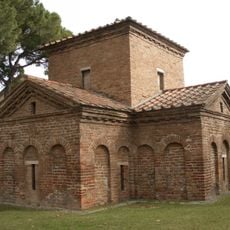
The Mausoleum of Galla Placidia was probably a chapel dedicated to Saint Lawrence, and although built as a mausoleum it never held the empress: Galla Placidia died and was buried in Rome. The starry dome is a mosaic of a cross at the centre with the symbols of the evangelists at its four ends.
The community of curious travelers
AroundUs brings together thousands of curated places, local tips, and hidden gems, enriched daily by 94,553 contributors worldwide.