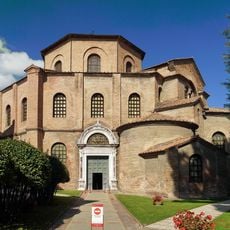
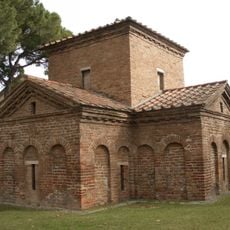
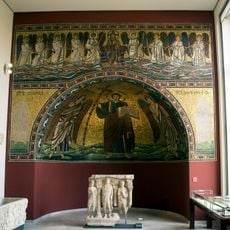
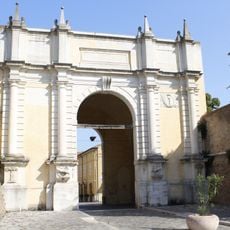
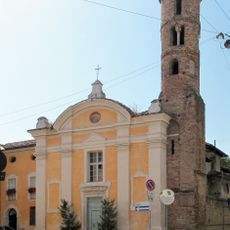
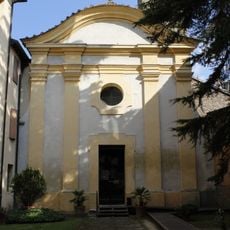
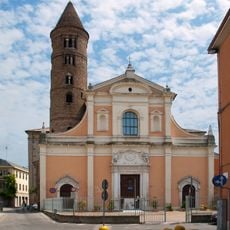
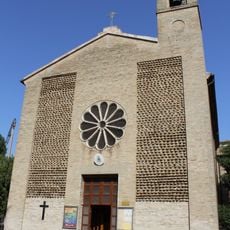
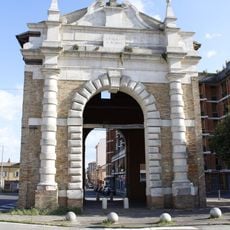
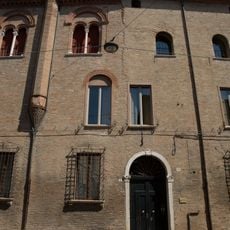
Church of Saint-Croce, Early Christian church building in Ravenna, Italy
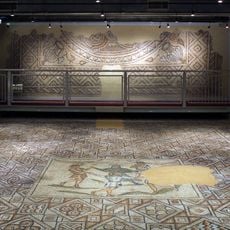
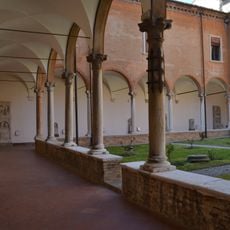
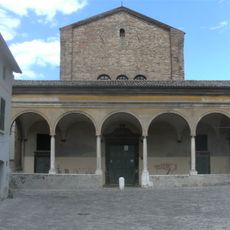
The church of Santa Croce was built in brick in the 5th century on a Latin-cross plan, a form otherwise unknown in Ravenna at the time. It had a single nave 11 metres wide, a wide north-south transept and a narthex; two 4-metre porticoes flanked the nave. The plan is not strictly rectilinear, with non-orthogonal wall joints and distorted transept ends.
The building was commissioned by Roman Empress Galla Placidia between 417 and 421 and built on foundations of a 3rd century Roman residence. The construction shows how early Christian sacred structures were integrated into the remains of the Roman city.
The dedication to the Holy Cross echoed the Basilica of Santa Croce in Gerusalemme, founded in Rome by Helena, mother of Constantine, and Galla Placidia used the cross on some of her coins. According to the historian Agnellus, the empress prayed at night prostrate on the porphyry floor of this church by candlelight. The building now serves as an exhibition hall.
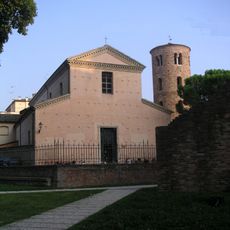
The church stands on Via Galla Placidia in central Ravenna, next to the Basilica of Santa Maria Maggiore and the Mausoleum of Galla Placidia. It is now used as an exhibition hall, so access depends on the current display rather than on church services. The surviving building is a single nave, reduced from the original Latin-cross plan.
The two 4-metre-wide porticoes flanking the nave had an unknown function; from at least the 6th century they held burials, cut through the geometric and plant mosaic paving. The church plan is not strictly rectilinear: wall junctions are non-orthogonal and the transept ends are distorted.
The community of curious travelers
AroundUs brings together thousands of curated places, local tips, and hidden gems, enriched daily by 94,520 contributors worldwide.