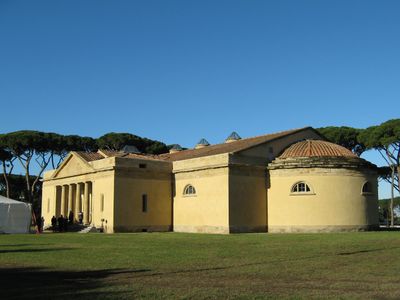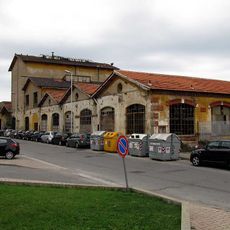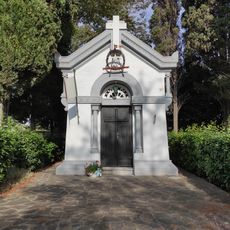
Cisternino di Pian di Rota, Neoclassical cistern in Pian di Rota, Livorno, Italy.
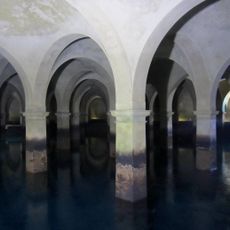
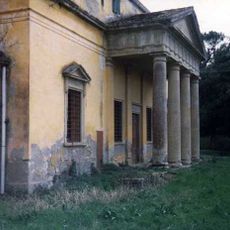
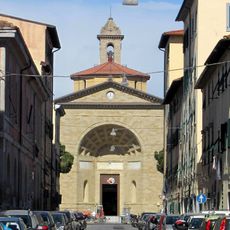
Cisternino di Pian di Rota is a neoclassical water storage building in Livorno featuring a rectangular form and portico supported by four Tuscan columns. Inside, the structure holds two distinct sections: the main reservoir and a filtration chamber filled with coal and gravel to purify the water supply.
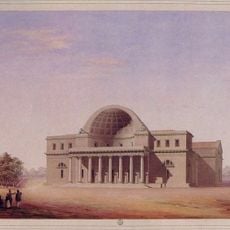
Pasquale Poccianti drew up the design in 1827 for the completion of the Colognole aqueduct, but construction only began in 1841. During building, the closed portico of the first plan was replaced by a Tuscan-columned pronaos with a pediment. Work ended in April 1852, when spring water from Colognole entered the building on its way to Livorno; by the end of the century the complex was cut off from the network and turned into a warehouse.
Locals call the building "Cisternino" to distinguish it from Poccianti's larger Cisternone; the name marks it as the smaller of Livorno's two neoclassical water works. The interior once held two basins, one for storage and one for purification through layers of coal and gravel, and the roof rests on 28 Tuscan pillars.
The building has narrow slit windows that provide minimal light inside, so give your eyes time to adjust to the dim conditions when entering. The structure is supported by twenty-eight Tuscan pillars that carry the vaulted roof, showing how builders used multiple supports to distribute weight evenly.
The narrow slit windows running along the whole avant-corps are a nod to 15th-century Tuscan architecture, while the semicircular thermal windows recall Roman baths. Poccianti's 1827 drawing had planned three blind arcades, but a Tuscan-columned pronaos with pediment was built instead.
The community of curious travelers
AroundUs brings together thousands of curated places, local tips, and hidden gems, enriched daily by 94,630 contributors worldwide.