Chiesa di Santa Lucia, Gothic church in Magliano de' Marsi, Italy
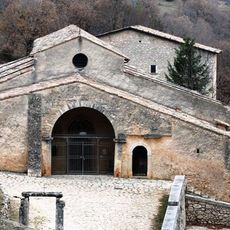
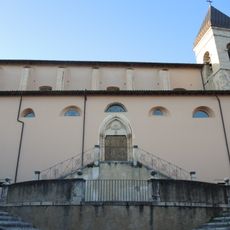
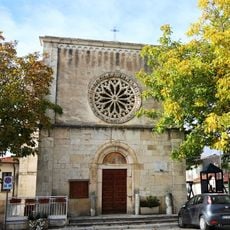
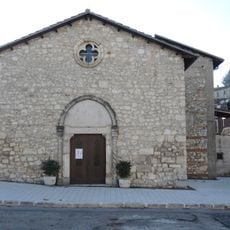
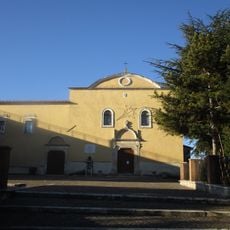
Chiesa di Santa Lucia has a rectangular facade with a horizontal cornice; its lower section, from the 14th century, holds three ogival portals, the central one with a lunette fresco of the Madonna and Child flanked by two saints. Above is a 15th-century rose window topped by a rectangular Baroque window added in an 18th-century restoration. Four carved bas-relief panels from the presbytery enclosure were remounted on the facade, one bearing the Latin inscription "Rotas opera tenet arepo sator". The interior has a Latin-cross plan with three naves separated by pillars.
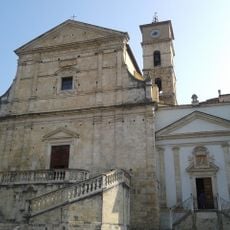
The church's foundation date is uncertain; it may stand on a Roman temple and share the town's origin, and was possibly first titled San Martino. The oldest document mentioning it dates to 1536, and the Cistercian facade is from the 1400s, when it became an abbey-collegiate church. The bell tower by Tommaso Di Lorenzo dates to 1880. Destroyed by the 1915 Avezzano earthquake, it was rebuilt in 1937 without Renaissance and Baroque additions.
The church is the main Catholic place of worship in Magliano de' Marsi, seat of a parish in the diocese of Avezzano. Its name comes from Saint Lucy, to whom the building is dedicated; the original structure probably bore the title of San Martino. Four relief panels from the presbytery enclosure were remounted on the facade during rebuilding, one bearing the Latin inscription "Rotas opera tenet arepo sator".
The church stands in the centre of Magliano de' Marsi, in the province of L'Aquila, and is the seat of the parish in the diocese of Avezzano. The facade faces the street, so the three portals, the fifteenth-century rose window and the four relief panels with the Latin inscription can be examined from outside. The bell tower rebuilt after 1915 rises beside it.
Four relief panels from the presbytery enclosure were reset into the rebuilt facade; one carries the Latin inscription "Rotas opera tenet arepo sator", the same palindrome found at San Pietro ad Oratorium in Capestrano. Look for it beside the fourteenth-century portals, where it is easily missed.
The community of curious travelers
AroundUs brings together thousands of curated places, local tips, and hidden gems, enriched daily by 93,828 contributors worldwide.