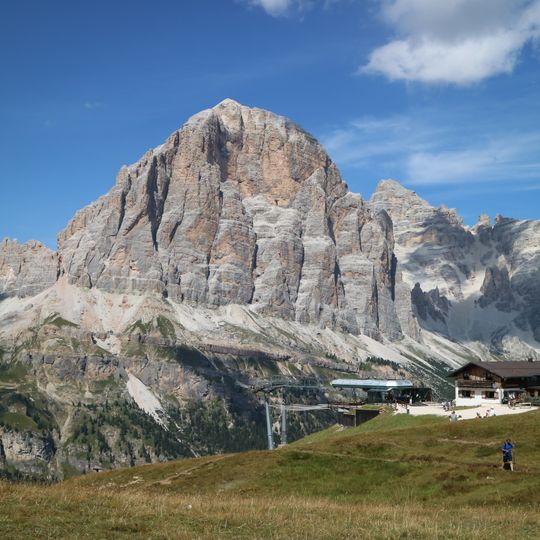
Tofana di Rozes, Mountain summit in the Dolomites, Italy
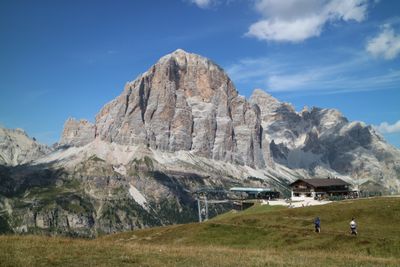
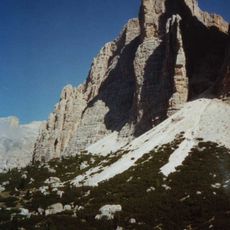
Tofana di Rozes is a 3,225-metre peak in the Dolomites of Belluno, Veneto, west of Cortina d'Ampezzo. From the north it appears as a three-edged rock pyramid; to the south it drops in an 800-metre wall above the Falzarego Pass. Its fractured grey and cream face rises above pale scree and grassy slopes.
Paul Grohmann, with Francesco Lacedelli, Angelo Dimai and Santo Siorpaes, made the first ascent on 29 August 1864 via the northeast flank from the Forcella Fontananegra. In July 1915 a patrol of the German Alpenkorps' third Jäger regiment took the previously unoccupied summit, which was held until 18 September. In February 1916 the Italians began tunnelling into the Castelletto, a 700-foot rock west of the main face, and on 11 July detonated 77,000 pounds of gelignite under the Austrian position.
The mountain's name appears in the local Ladin and Ampezzan tradition, and the peak is still climbed by the normal route from Rifugio Giussani. Near the Castelletto, the restored entrance of the mine tunnel marks where Italian troops began tunnelling in February 1916; a via ferrata now starts there and passes a memorial to Giovanni Lipella, an Italian soldier killed on the mountain on 15 June 1918 and posthumously awarded the Gold Medal of Military Valour.
The mountain can be approached via several different routes depending on your climbing experience and goals. Accommodation options are available at mountain refuges along the way, making it possible to break up the climb across multiple days.
While climbing, mountaineers pass through a network of well-preserved tunnels and caves from World War I that are still accessible today. These underground structures reveal the engineering effort and resourcefulness required to fortify this remote alpine location during wartime.
The community of curious travelers
AroundUs brings together thousands of curated places, local tips, and hidden gems, enriched daily by 93,441 contributors worldwide.