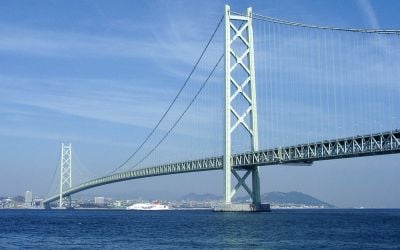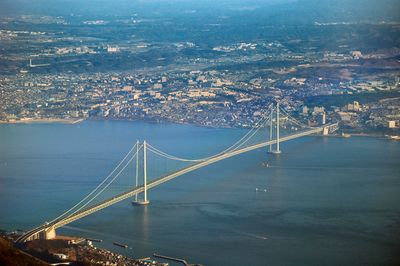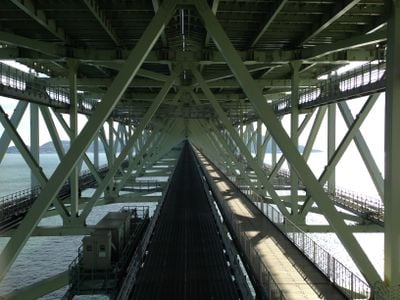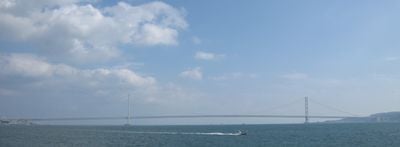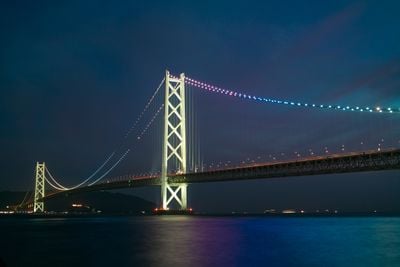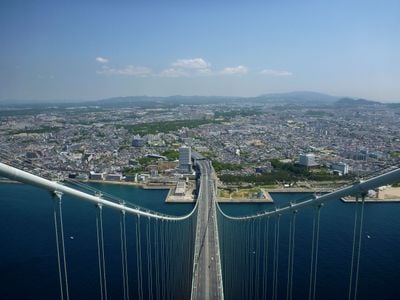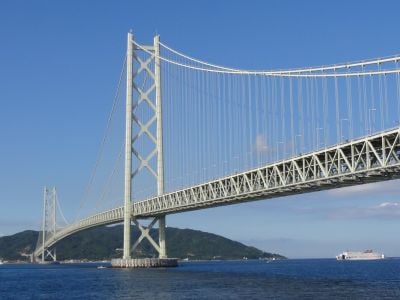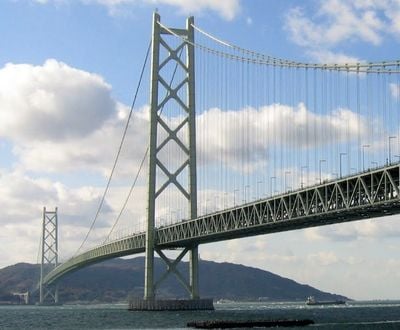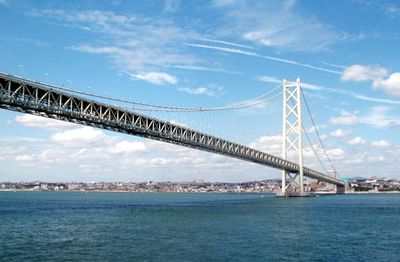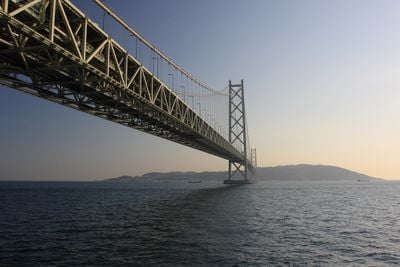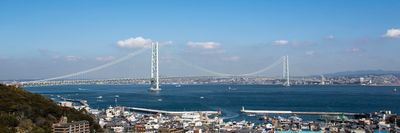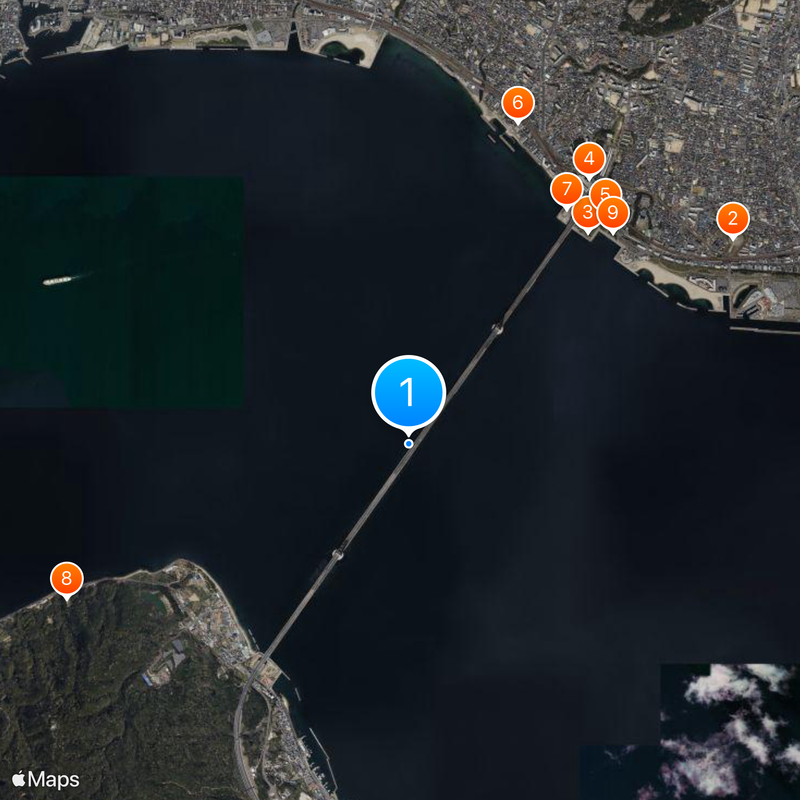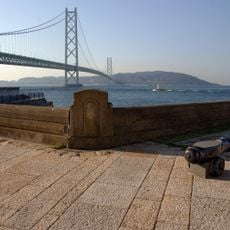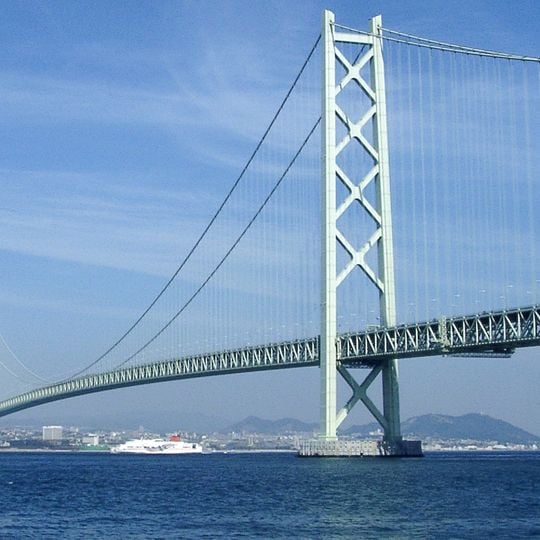
Akashi Kaikyō Bridge, Suspension bridge connecting Kobe to Awaji Island in Japan.
This steel suspension bridge spans 3,911 meters across the Akashi Strait, featuring a central span of 1,991 meters and towers rising 282.8 meters above sea level.
Construction began in September 1996 and was completed in April 1998, after decades of planning following fatal ferry disasters in 1955 that claimed 168 lives.
The structure received the Tanaka Prize from the Japan Society of Civil Engineers and is listed among 100 bridges in Japan recognized for engineering significance.
The bridge carries six lanes of traffic between Tarumi-ku and Awaji, operated by the Honshu-Shikoku Bridge Authority, with observation points available at Maiko Marine Promenade.
During the 1995 Kobe earthquake, the bridge's central span stretched by one meter, extending its length from the originally planned dimensions while remaining structurally sound.
Location: Tarumi-ku
Location: Awaji
Inception: September 18, 1996
Official opening: April 5, 1998
Height: 282.8 m
Length: 3,911 m
Operator: 本州四国連絡高速道路
Part of: Honshū-Shikoku Bridge Project, 100 bridges in Japan
Website: https://jb-honshi.co.jp/english
GPS coordinates: 34.61639,135.02028
Latest update: November 28, 2025 14:28
This collection brings together some of the most outstanding transport structures worldwide, representing engineering ingenuity and technical daring from various eras. From the Akashi Kaikyō Bridge of Japan, which holds the global record for span length at 1,991 meters (6,532 feet), to the Landwasser Viaduct in Switzerland, built in 1902 and opening directly into a mountain tunnel, each structure tells a story of overcoming geographical challenges. These constructions connect areas separated by bays, straits, deep valleys, or waterways. The Hangzhou Bay Bridge in China stretches 36 kilometers (22 miles) across the waters of the East China Sea, while the Chesapeake Bay Bridge-Tunnel in the United States cleverly combines two modes of crossing over 37 kilometers (23 miles). In Scotland, the Forth Bridge has spanned the estuary since 1890 with its three distinctive steel cantilever spans, and in Bordeaux, the Jacques Chaban-Delmas Bridge stands out as Europe's tallest bascule bridge. Beyond facilitating transport, these structures have become visual landmarks and destinations in their own right. The Royal Gorge Bridge in Colorado overlooks the Arkansas River by 955 feet (291 meters), while London's Millennium Bridge offers a direct pedestrian route between the Tate Modern and Saint Paul’s Cathedral. Each of these sites warrants a visit to appreciate the scope of technical achievement they embody.
This collection gathers bridges and engineering structures that mark the history of modern infrastructure worldwide. Structures such as the Akashi-Kaikyo Bridge in Japan, with its span of 3,911 meters, or the 37-kilometer Chesapeake Bay Bridge-Tunnel in Virginia demonstrate technological advances made to cross natural obstacles. These include suspension bridges, cable-stayed bridges, and viaducts that often set records for length or height. From the Confederation Bridge linking Prince Edward Island to New Brunswick in extreme weather conditions, to the Øresund Bridge connecting Denmark and Sweden, these structures change the geography and facilitate exchanges between regions. The Vasco da Gama Bridge in Lisbon, the Norman Bridge crossing the Seine at Honfleur, or the Yavuz Sultan Selim Bridge in Istanbul illustrate how modern engineering addresses transportation needs while adapting to each site's geographic constraints.
Bridges are a part of our daily lives. They have connected banks, valleys, and communities for centuries. This collection presents structures from various periods and regions. From medieval stone arches to modern steel constructions, these works demonstrate the evolution of engineering. The Rialto Bridge from the 16th century in Venice spans the Grand Canal with a single stone arch. The Golden Gate in San Francisco stretches over 1.7 miles (2.7 km), linking the city to northern California. In Singapore, the Helix Bridge forms a pedestrian link in Marina Bay with its double-helix structure. These structures serve practical purposes in urban transportation while shaping city skylines. They provide technical solutions to geographical barriers and reflect different approaches to bridge construction through the ages.
This collection presents suspension bridges recognized for their engineering solutions and their role in urban development. The Akashi Kaikyō Bridge in Japan spans 1,991 meters between its two towers, the longest distance of its kind in the world. The Golden Gate Bridge in San Francisco demonstrates 1930s engineering with its 1,280-meter main span. In New York, the Brooklyn Bridge has connected Manhattan to Brooklyn since 1883 and serves as an early reference point in modern bridge construction. The Humber Bridge in England held the record for the longest span from 1981 to 1998. In Istanbul, the Bosphorus Bridge has linked Europe to Asia since 1973 across a span of 1,074 meters. The Tower Bridge in London has combined a bascule bridge with suspension elements since 1894. These structures document the evolution of construction techniques over more than a century and remain important transportation routes in their respective regions.
This collection gathers bridges that hold world records for span length, defined as the distance between two main pylons. While the longest bridge in the world measures 165 kilometers in China, this refers to the maximum span covered in one continuous structure. These constructions demonstrate engineering achievements in crossing maritime straits, rivers, or valleys without intermediate supports. The Çanakkale Bridge in Turkey crosses the Dardanelles Strait with a span of 2,023 meters, setting the current record for suspension bridges. In Japan, the Akashi Strait Bridge connects Kobe to Awaji Island with a central span of 1,991 meters. In China, several bridges exceed 1,600 meters in span, such as the Yangsigang Bridge over the Yangtze in Wuhan or the Xihoumen Bridge in the Zhoushan Archipelago. South Korea with the Yi Sun-sin Bridge, Denmark with the Great Belt Bridge, and Turkey with the Osman Gazi Bridge complete this list of remarkable structures. These bridges are interesting destinations for observing modern civil engineering accomplishments. They connect cities and regions, significantly reducing travel times while offering scenic views of the landscapes they cross. Visiting them allows appreciation of the scope of work involved in constructing these infrastructures under often challenging conditions.
Goshikizuka kofun
2.8 km
Akashi Municipal Planetarium
4.1 km
Okura Coast
3.1 km
Watatsumi-jinja
3.4 km
Sun Yat-sen Memorial Hall
2 km
Tio舞子
2.3 km
Awajishima Park
4.7 km
Hyogo Prefectural Maiko Park
2.2 km
Maikoroku-jinja
2.5 km
Akashi Municipal Library
4.4 km
Inazume-jinja
3.6 km
Gesshō-ji
4.1 km
Akashi City Council
3.6 km
神戸大学附属幼稚園
4.2 km
Akashi Kaikyo Bridge Exhibition Center
2 km
Esaki Lighthouse
2.7 km
Former Muto Villa, Kobe
2.1 km
Iwaya-jinja
4.2 km
Maiko Battery Site
2.2 km
Former Kinoshita House
2.4 km
Akashi City Museum of Culture
4.5 km
Honsho-ji
4.3 km
Muryoko-ji
4.7 km
中崎公会堂
3.5 km
Akashi Port Old Lighthouse
4 km
Unsei-ji
4.1 km
Koke-ji
4.5 km
Akashi Municipal Cultural Museum
4.5 kmReviews
Visited this place? Tap the stars to rate it and share your experience / photos with the community! Try now! You can cancel it anytime.
Discover hidden gems everywhere you go!
From secret cafés to breathtaking viewpoints, skip the crowded tourist spots and find places that match your style. Our app makes it easy with voice search, smart filtering, route optimization, and insider tips from travelers worldwide. Download now for the complete mobile experience.

A unique approach to discovering new places❞
— Le Figaro
All the places worth exploring❞
— France Info
A tailor-made excursion in just a few clicks❞
— 20 Minutes