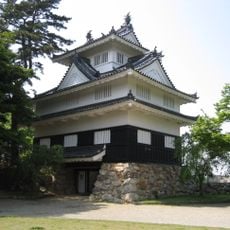
Nirengi Castle, Japanese castle in Toyohashi, Japan
Nirengi Castle was a Sengoku-period castle on a terrace by the Asakura River in what is now Toyohashi. Its main courtyard covered about 600 square meters, with the lord's residence in the north courtyard. Today Ōguchi Park occupies the main courtyard, earthen ramparts remain around it, and part of the dry moat survives at the base of the slope.
Toda Munemitsu built Nirengi Castle in 1493 as a forward base against Tame Matasaburo, who had raised Funagatayama Castle the year before. Munemitsu died in 1508 and his son Norimitsu moved into the castle, which stayed with the Toda until 1590. That year Toda Yasunaga followed Tokugawa Ieyasu east, and Ikeda Terumasa, installed at Yoshida Castle, had the now-redundant castle abandoned.
The castle's name comes from the elm trees (ren-no-ki) that once grew in abundance here. During the Edo period, impoverished samurai living around the site used elm wood to craft surikogi, wooden pestles for grinding sesame and spices, and sold them to merchants to supplement their stipends.
The park occupies the former main courtyard, about 600 square meters, with the Senior Citizens' Welfare Center on the secondary courtyard. Earthen ramparts remain around the main courtyard, and part of the original dry moat survives at the base of the slope below it. Reach the site from Toyohashi Railway's Higashida tram stop, then walk north about five minutes; the stop has no safety island, so watch for passing cars.
The name comes from two elm trees that once grew widely in the area, with the Japanese name literally meaning 'two elm trees.' These trees were so characteristic of the place that they became the basis for the castle's name.
The community of curious travelers
AroundUs brings together thousands of curated places, local tips, and hidden gems, enriched daily by 94,680 contributors worldwide.