National Diet Building, Parliament building in Nagatachō, Tokyo, Japan
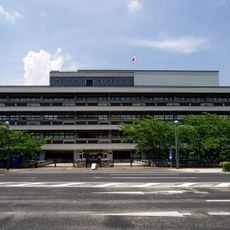
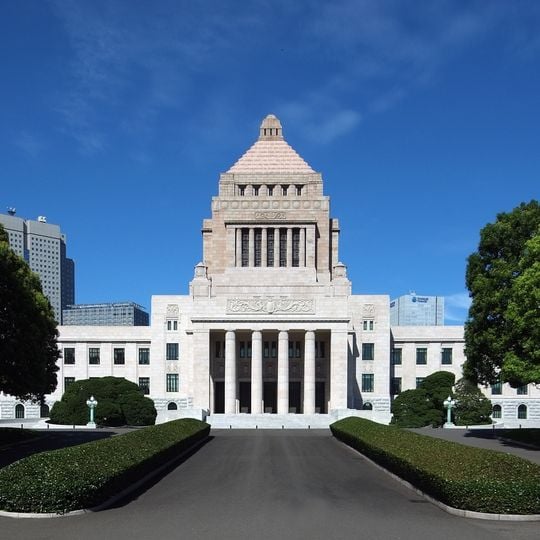
The National Diet Building is a neoclassical parliament building in the Nagatachō district of Tokyo, Japan, with a central tower rising about 65 meters high. The symmetrical structure is made of stone and steel-reinforced concrete and includes two side wings that house the two parliamentary chambers, as well as a multi-story central hall with a wide staircase.
The Diet met in temporary wooden buildings from 1890; the first burned down in January 1891 after an electrical fire, and the second was destroyed by fire in 1925. Construction of the present building began in 1920 on a design chosen in the 1918 public competition, won by Watanabe Fukuzo. It was completed on 7 November 1936, and since 1946 it has housed the National Diet under the new constitution.
The building's name comes from the Kokkai, the two-chamber parliament that meets here: the House of Representatives in the south wing and the House of Councillors in the north. The central entrance's bronze doors, 3.94 m tall and made by the Tokyo School of Fine Arts, are called "the door that never opens" because they are used only for the first session after an election, for the Emperor or visiting heads of state, and during open-house events.
Tours of the parliament run on weekdays and allow access to the grand hall and chamber rooms, with visitors needing to apply in advance. The visit takes about an hour and includes passing through security checks at the entrance, so guests should allow extra time.
The central entrance is called "the door that never opens": it is used only when members attend their first session after an election, when the Emperor or foreign heads of state are received, and during open-house events. Its bronze doors, made by the Tokyo School of Fine Arts, stand 3.94 m tall and weigh 1.125 tonnes each.
The community of curious travelers
AroundUs brings together thousands of curated places, local tips, and hidden gems, enriched daily by 94,106 contributors worldwide.