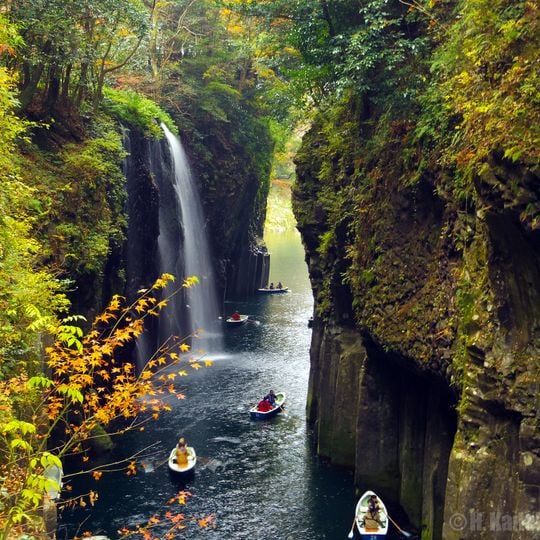
Takachihokyo, Natural gorge in Takachiho, Japan.
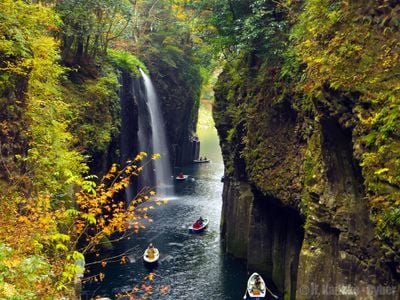
Takachihokyo is a V-shaped gorge on the Gokase River, about 25 km southeast of Mount Aso. Its near-vertical walls, averaging 80 m and reaching 100 m, are made of welded Aso pyroclastic-flow deposits with columnar jointing, resting on Chichibu slate and sandstone. The gorge runs 7 km east-west, and Manai Falls drops 17 m into the river.
The gorge was formed when pyroclastic flows from Mount Aso, erupted about 120,000 years ago, cooled and welded into andesite with columnar joints; the Gokase River then cut a V-shaped valley through it. A younger flow, from about 90,000 years ago, caps the upper walkway. In 1934 it was designated a Place of Scenic Beauty and Natural Monument as the Gokase River Gorge, and in 1965 it became part of the Sobo-Katamuki Quasi-National Park.
Manai Falls, at the centre of the gorge, is tied to the deity Amenomurakumo-no-Mikoto, who according to myth moved a water source here when the land had none during the descent of the heavenly grandchild; the spring became the Tennen Manai and now falls 17 m. The gorge and its falls are among Japan's Top 100 Waterfalls, and from mid-July to mid-September the falls are lit until 10 p.m.
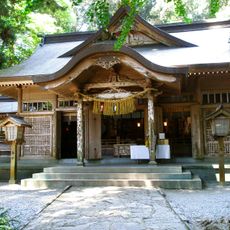
The 1 km promenade along the gorge links Manai Falls, the Sennin no Byobu rock and the Yaritobi Bridge, continuing to Takachiho Shrine; the stretch from the bridge is a stepped mountain path, so wear walking shoes. The promenade fully reopened on 1 March 2024 after Typhoon No. 14 closed part of it in 2022. Rental boats reach close to the 17 m Manai Falls.
The cliffs are made of welded Aso pyroclastic-flow deposits, not basalt: an older unit about 120,000 years old forms the lower gorge, and a roughly 90,000-year-old flow lies above the walking path. The two are welded together, and the columnar joints cut through this rock.
The community of curious travelers
AroundUs brings together thousands of curated places, local tips, and hidden gems, enriched daily by 93,144 contributors worldwide.