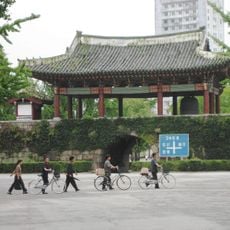
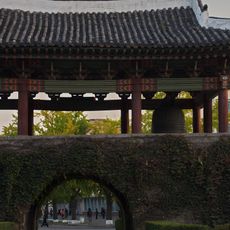
Manwoldae, Royal palace ruins in Kaesong, North Korea.
Manwoldae is the ruined main palace of the Goryeo Dynasty on the southern slope of the Songak Mountains in Kaesong. Its core was Hoegyŏng Hall, the throne hall built between 1020 and 1023, with the Changhwa and Wŏndŏk Halls behind it and the Chŏmsŏngdae astronomy tower in the complex. The palace was divided into the Kungsŏng, where the royal family lived, and the Hwangsŏng, where state affairs were conducted; the east, west and north walls of the inner enclosure survive, built of alternating layers of stone and clay.
Construction began in 919 at the start of the Goryeo Dynasty, south of the Songak Mountains. The palace was destroyed by fire in 1011, 1126, 1171, 1225 and 1362; the Hoegyŏng Hall throne room was rebuilt from 1020 to 1023. The 1361 Red Turban sack forced the king to flee to Andong. Sunjong visited the ruins on 31 January 1909.
The name Manwoldae comes from Mangwoldae, a platform built to view the full moon on the first lunar month, and was applied to the ruins in the Joseon period. The site is also linked to the 1928 popular song "Hwangseong Yet Teo" by Lee Ae-ri-su.
Visiting the archaeological site requires advance planning through authorized North Korean tour operators who handle all access arrangements. Visitors should expect guided protocols and designated routes across the grounds.
Excavations at Manwoldae have yielded over 3,000 roofing tiles, along with ceramics, mirrors and ancestral tablets. Among the finds is a 25 cm celadon jar with an inlaid monkey and tree design in gold underglaze, now held at the National Museum of Korea. A two-feet celadon cylinder with peony and vine patterns, its purpose still unclear, was also unearthed.
The community of curious travelers
AroundUs brings together thousands of curated places, local tips, and hidden gems, enriched daily by 93,466 contributors worldwide.