Heunginjimun, City gate in Seoul, South Korea
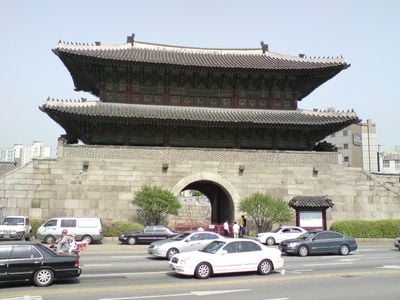
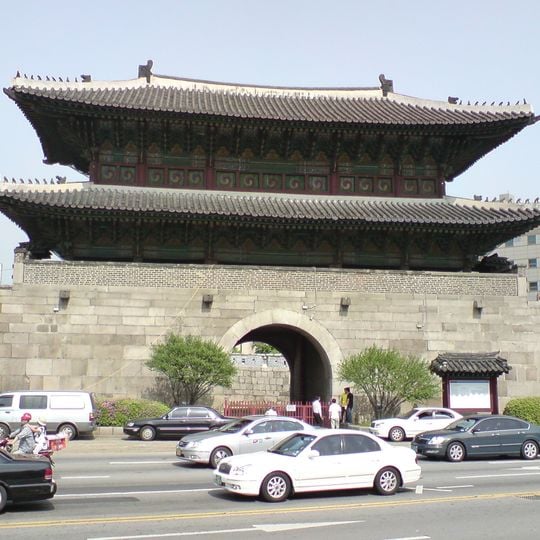
Heunginjimun is the eastern gate of Seoul's fortress wall, built on a massive base of light grey and tan granite blocks pierced by a single arched tunnel. Above the stone runs a band of pale brickwork, topped by a two-story timber pavilion with five front bays and two side bays. Its two stacked roofs of dark grey tiles have upturned corners, and green-and-red painted brackets with circular motifs line the facade beneath each roof.
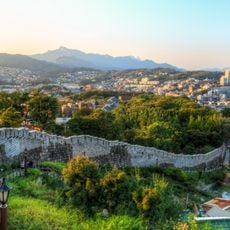
King Taejo's fifth-year project began in 1396 but soft ground delayed completion until 1398, when the gate was named Heunginmun. It was repaired in 1453 under King Danjong after the city wall was rebuilt, and the present structure dates from a reconstruction finished in March 1869 under King Gojong. In 1907 the flanking walls were partly demolished for tram tracks.
The gate's name was expanded from the three-character Heunginmun to the four-character Heunginjimun in 1869, adding the character ji (之) to reinforce the weak eastern energy of Seoul according to feng shui. Its name plaque is therefore the only square, four-character plaque among the four main gates. Locals still call it Dongdaemun, meaning Great East Gate.
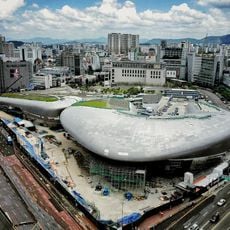
Heunginjimun stands at Jongno 6-ga, at the intersection of subway lines 1 and 4; Dongdaemun station exits 1 and 6–10 bring you to the gate. The ongseong and gate can be viewed from the surrounding roadway and pavement, and the Dongdaemun Design Plaza, opened in 2014, is nearby.
The gate's name plate is the only one among Seoul's main gates with four characters arranged in a square: the extra 之 was added in 1869 to strengthen the eastern district's weak energy according to feng shui. The gate was also the first Korean structure registered as Treasure No. 1 under the Japanese colonial administration.
The community of curious travelers
AroundUs brings together thousands of curated places, local tips, and hidden gems, enriched daily by 94,061 contributors worldwide.