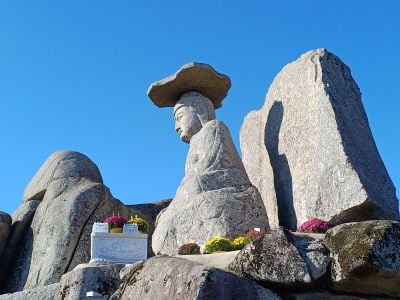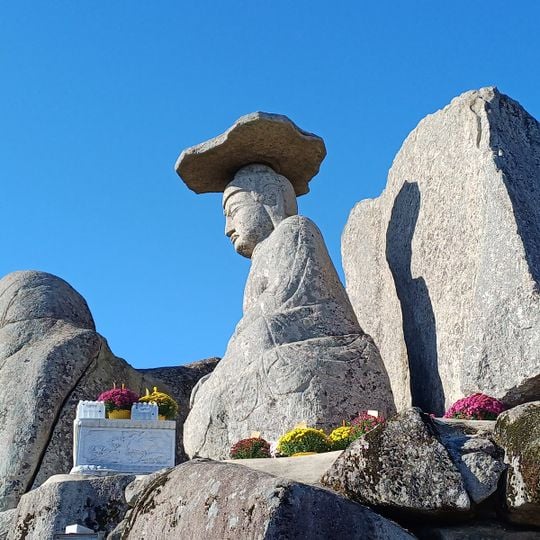
Gatbawi, Buddhist statue on Palgongsan Mountain, South Korea.
Gatbawi is a 4-metre-tall granite Buddha carved from a natural rock outcrop at the top of Gwan Peak on Palgongsan Mountain. It sits against a screen-like rock wall, with a flat stone hat about 15 centimetres thick on its head. The statue is a Treasure of the Republic of Korea.
The sources disagree on the date: tradition credits the monk Uihyeon with carving the statue in 638, the seventh year of Queen Seondeok, to appease his mother's soul, while its stiff face, formalized drapery and flat body point scholars to the early 9th century. The eight-sided lotus crown was added later, and the figure was called Maitreya until 1963, when it was renamed a Medicine Buddha. It became a Treasure of the Republic of Korea on 1 September 1965.
The flat stone on the head resembles a graduate's mortarboard, so students and their parents climb here to pray before exams. The statue has been called Seokgamoni, Amitabha and Maitreya over the centuries, and only since the 1960s has it been known as the Medicine Buddha, Yaksa Yeorae.
From the Daegu side, bus 401 runs every 10 minutes to the Gatbawi parking lot; a 1,365-step staircase then leads up in about 45 minutes. From Gyeongsan, bus 803 runs every 30 to 60 minutes to Seonbonsa Temple, from where a 25-minute path climbs to the statue. The Gyeongsan route is gentler and is cleared of ice in winter.
The hat is not a natural stone: a 2012 3D scan by Seonbonsa and the Buddhist Culture Research Institute found a five-petaled lotus carved on its top, suggesting an octagonal crown later weathered into its present shape.
The community of curious travelers
AroundUs brings together thousands of curated places, local tips, and hidden gems, enriched daily by 93,561 contributors worldwide.