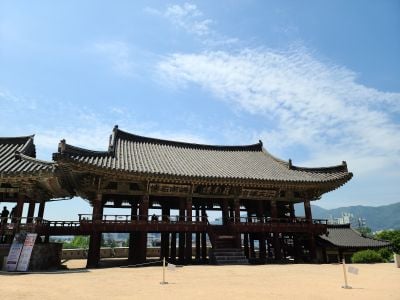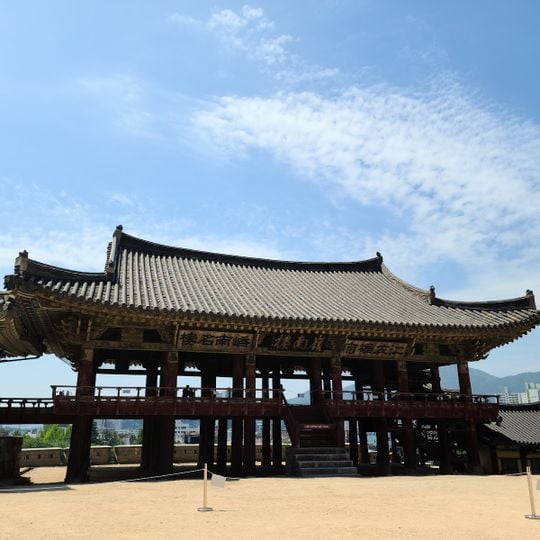
Yeongnamnu, Historical pavilion in Miryang, South Korea
Yeongnamnu is a traditional pavilion built on a cliff overlooking the Miryang River, featuring curved roofs and wooden columns characteristic of Korean architecture. The elevated position offers views across the river and surrounding landscape.
A pavilion existed here in the Silla period as part of Yeongnamsa temple; after the temple vanished, a successor structure was built in the late Goryeo period and attached to the Miryang guesthouse. Fire destroyed the great hall and its wings in 1582, and the pavilion was rebuilt in 1637. Fire struck again in 1842, and magistrate Yi In-jae rebuilt the present structure in 1844.
The name Yeongnamnu means "south of the pass", shared with the Yeongnam region; the pavilion's name may refer to Paljoryeong. It was attached to the Miryang guesthouse, where officials travelling the Great Yeongnam Road between Hanyang and Busan were received and banquets held. Stone-carved Joseon calligraphy fills the complex, and the Aranggak pavilion stands nearby.
The pavilion is most easily reached by public transportation and sits near other historical sites such as Miryang City Museum. The best time to visit is during daylight hours when the architecture and river views are clearly visible.
This pavilion served as a well-known rest stop on the Great Yeongnam Road, a major route connecting Seoul and Busan, where officials and travelers paused during their journeys. Many of these visitors left their names and thoughts carved into stone, inscriptions that remain visible today.
The community of curious travelers
AroundUs brings together thousands of curated places, local tips, and hidden gems, enriched daily by 93,673 contributors worldwide.