Hadzhoh gorge, Natural monument in Kamennomostsky, Russia
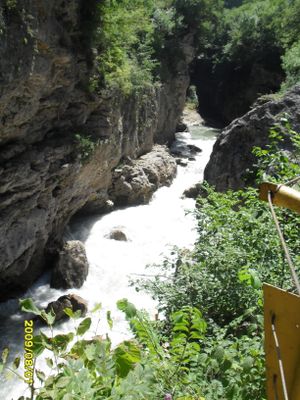
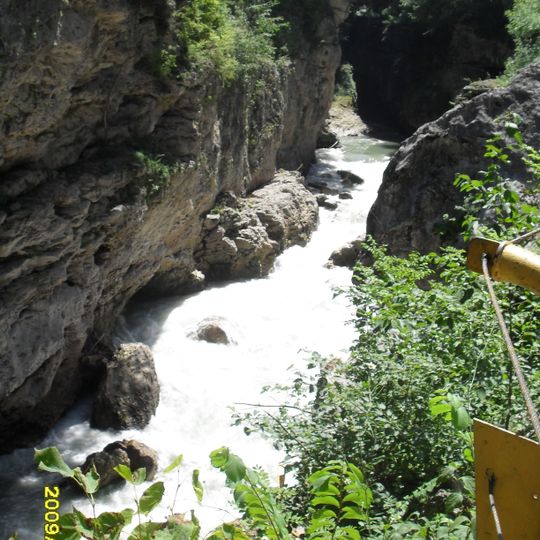
Hadzhoh gorge is a 400-metre section of the Belaya River valley on the southwestern edge of Kamennomostsky. Its limestone walls, cut by water dissolving the fractured rock, close to a width of 6–7 metres and a depth of 35 metres. A road bridge crosses the gorge and divides the walking route into two parts.
The gorge was cut by the Belaya River dissolving and eroding fractured limestone, a process the sources describe as unfolding over tens of thousands of years as the river incised and the mountains rose. In 1979 the canyon was designated a natural monument of republican significance.
The gorge lies on the southwestern edge of Kamennomostsky, a settlement whose name means "stone bridge"; the road bridge over the canyon splits the walking route in two. In the lower section, enclosures hold bears, wolves, foxes, otters and ostriches of the local fauna. The canyon has been a republican-level nature monument since 1979.
The route runs along built paths, stairs and railings, and a road bridge over the canyon splits it into two halves; the animal enclosures lie in the downstream half. The gorge is 6–7 m wide and 35 m deep, so the river is heard before it is seen. Approach from the left bank of the Belaya, where the valley stays hidden until the bridge.
The gorge lies on the southwestern edge of Kamennomostsky, and the road to the left bank of the Belaya gives no view of the river valley until you reach the bridge, where a 6–7 m wide, 35 m deep chasm opens. Past the gorge the river slows and widens to 50–60 m. Since 1979 the canyon has been a republican-level natural monument.
The community of curious travelers
AroundUs brings together thousands of curated places, local tips, and hidden gems, enriched daily by 94,466 contributors worldwide.