Hydroelectric Power Station in Bely Ugol village, Hydroelectric power station museum in Yessentuki, Russia
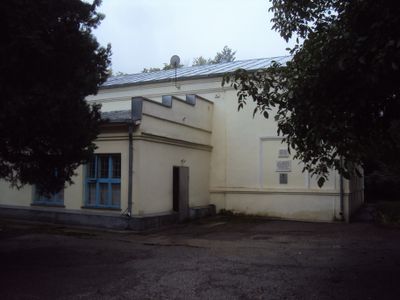
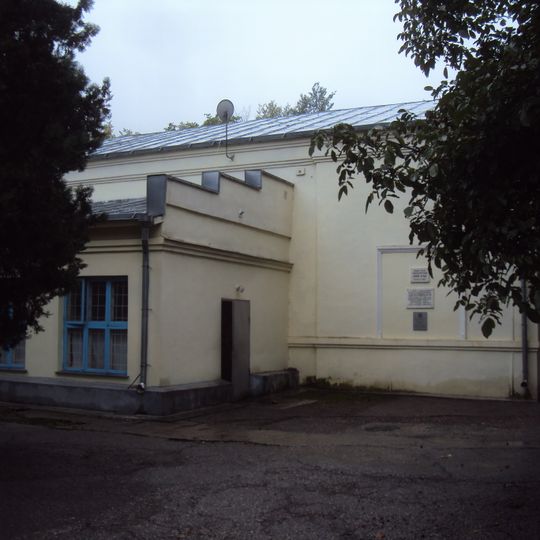
The Hydroelectric Power Station in Bely Ugol village is a decommissioned derivation-type plant on the Podkumok River near Yessentuki. Its cream-coloured, single-storey building has a pale yellow facade over a grey stone base, a low seamed-metal roof with a satellite dish, and a large multi-paned window with bright blue frames. A white panel on the right facade holds three plaques; the station has housed a museum since 2003.
The station was built in the early 1900s and was among the first of its kind in the entire North Caucasus. It brought electricity to the spa towns of the region, changing daily life in Yessentuki and the surrounding resort areas.
The station was renamed Bely Ugol, "white coal", in 1911, replacing its original name, Central Pyatigorsk Hydroelectric Station. The term presented waterpower as a clean fuel. A plaque on the building records that Professor Shatelen ran the first parallel operation of two power stations in Russia and the world here in March 1913.
The station stands on the Podkumok about 6 km from Yessentuki, on land bought from the Yessentuki stanitsa Cossack community. The building has housed a museum since 2003, so visits are to the exhibition rather than to working machinery. The water intake was destroyed by floods in 1977 and 2002, and the station has been shut down since 1977.
A plaque on the wall records that Professor Shatelen ran the first parallel operation of two power stations in Russia and the world here in March 1913, linking this plant with Pyatigorsk's diesel station over 20 km of 8 kV lines; the principle later fed into the GOELRO plan and the Soviet unified grid.
The community of curious travelers
AroundUs brings together thousands of curated places, local tips, and hidden gems, enriched daily by 93,849 contributors worldwide.