Remains of the Stone Walls at Dashawan, Archaeological site and historic building in Zhengsha Village, Taiwan
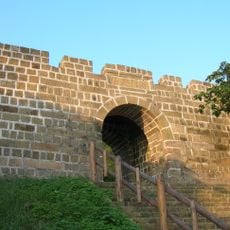
The Remains of the Stone Walls at Dashawan are the surviving sections of a Qing-era military wall built in 1876 to protect the Jilong (Ershawan) battery. The remains form a U-shaped, flat battery layout. The best-preserved section shows a sanhetu wall capped with sandstone, while the lower part is rammed earth containing glutinous rice, locally called mochi city.
The stone enclosure was built in 1840 as part of Keelung's coastal defences, and was damaged in 1841 during the First Opium War. In 1876 the Qing rebuilt the Jilong fort as a modern battery and added the stone wall to shield it from naval gunfire and tidal erosion. French forces captured and destroyed the battery on 5 August 1884, after which Liu Mingchuan built new hilltop forts and the wall fell into disuse.
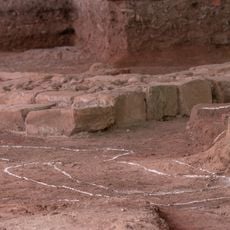
Locals call the lower rammed-earth section "mochicheng" (rice-cake wall) because glutinous rice was mixed into the earth. The wall linked the surrounding barracks, and its sandstone blocks sit on a lime-sand wall. Look for long mortise slots and traces of iron fittings, evidence of repeated repairs after completion.
The remains lie on Zhongzheng Road in Zhongsha Village, Zhongzheng District, Keelung, within the Shawan Historical and Cultural Park. Since 2021 they have been part of this park, where paths link them with nearby monuments. Some fragments are inside private houses on the east side, so only the outdoor sections can be viewed.
The lower section of the wall is rammed earth mixed with glutinous rice, which locals nicknamed "mochi city". Recent surveys also found long mortise slots and traces of iron fittings, showing the wall was repaired several times after completion.
The community of curious travelers
AroundUs brings together thousands of curated places, local tips, and hidden gems, enriched daily by 93,636 contributors worldwide.