Rostov Sea, reservoir in Russia
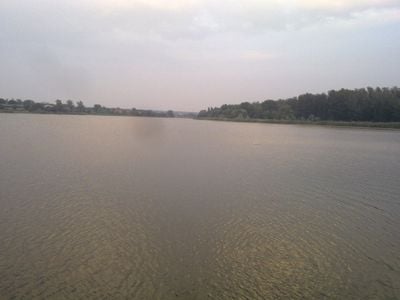
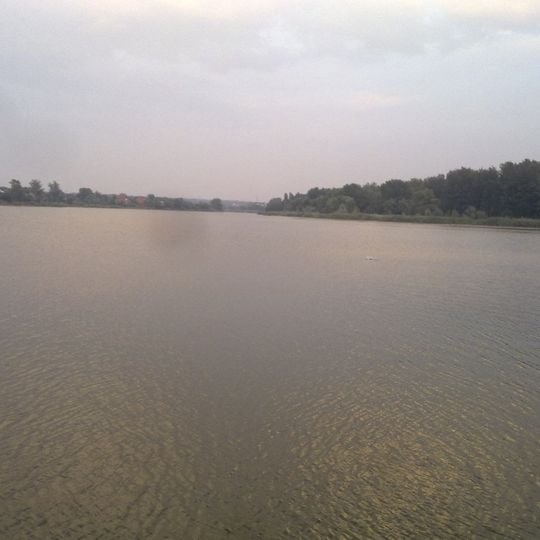
Rostov Sea is a reservoir on the Kamyshevakha gully at the northern edge of Rostov-on-Don, not a dammed river. Its still, grayish-brown water fills most of the view, with fine ripples in the foreground and a smoother surface farther out. A thin strip of land edged with dark green trees and shrubs runs horizontally across the middle distance.
The reservoir was created in the 1960s to flush the polluted Temernik River, fed by a floating pumping station on the Aksay that lifted water 100 m through six buffer ponds. Builders found shell limestone at the outlet draining the basin; a polyethylene liner failed and a clay-silicate seal replaced it, delaying commissioning to 1971. After the first effective flush, the RSFSR Council of Ministers ordered two more reservoirs in the Severny district, completed in 1976.
The name "sea" is informal: the reservoir is fed by a diversion from a backwater of the Aksay River, pumped up to 100 metres through a floating station. Six ponds between the intake and the Rostov Sea act as buffer and recreation zone. The reservoir's discharge flushes the Temernik riverbed.
The reservoir lies on the northern edge of Rostov-on-Don, in the Kamyshevakha gully. Water is released in bursts of up to 10 m³/s to flush the Temernik riverbed, so levels can change. Six ponds between the reservoir and the supply point act as a buffer and recreation zone.
The reservoir was meant to flush the Temernik with bursts of up to 10 m³/s, but builders found shell limestone at the outlet that let water seep into the ground. A polyethylene liner failed quickly, so a clay-silicate seal was used, delaying commissioning until 1971, two years late.
The community of curious travelers
AroundUs brings together thousands of curated places, local tips, and hidden gems, enriched daily by 93,656 contributors worldwide.