See the monuments around you in AROpen chests in the app
Around Us is built for your phone — point your camera at the streets and discover the monuments and places around you in augmented reality.Around Us is built for your phone — chests unlock when you walk, explore and capture nearby places.
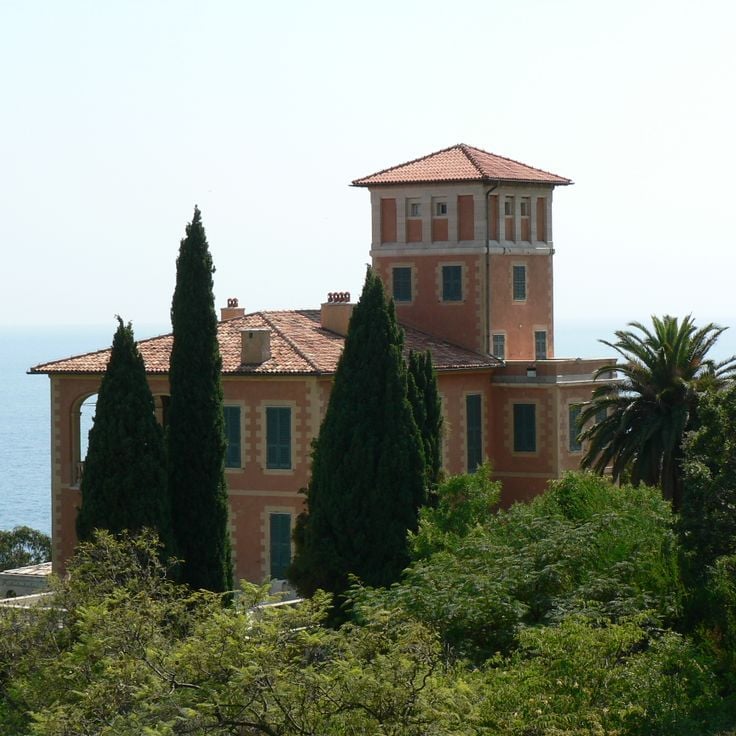
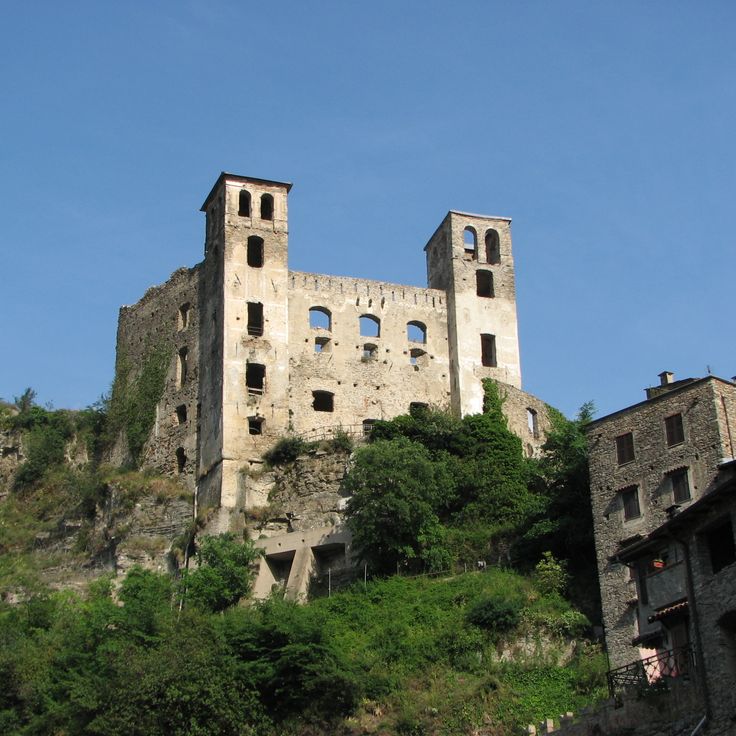
Liguria stretches as a narrow coastal strip between the Maritime Alps and the Apennines, combining maritime tradition with mountainous interior. Along the Riviera di Ponente in the west lie towns such as Dolceacqua with its medieval Doria Castle, the fortified town of Noli, and the Hanbury Botanical Gardens near La Mortola. The Riviera di Levante in the east features the Cinque Terre National Park with its coastal villages, Portofino with Castello Brown, and the Baia del Silenzio in Sestri Levante. Finalborgo preserves its medieval structure within the walls of Finale Ligure, while Vernazza with the Church of Santa Margherita d'Antiochia above the harbor belongs to the Cinque Terre.
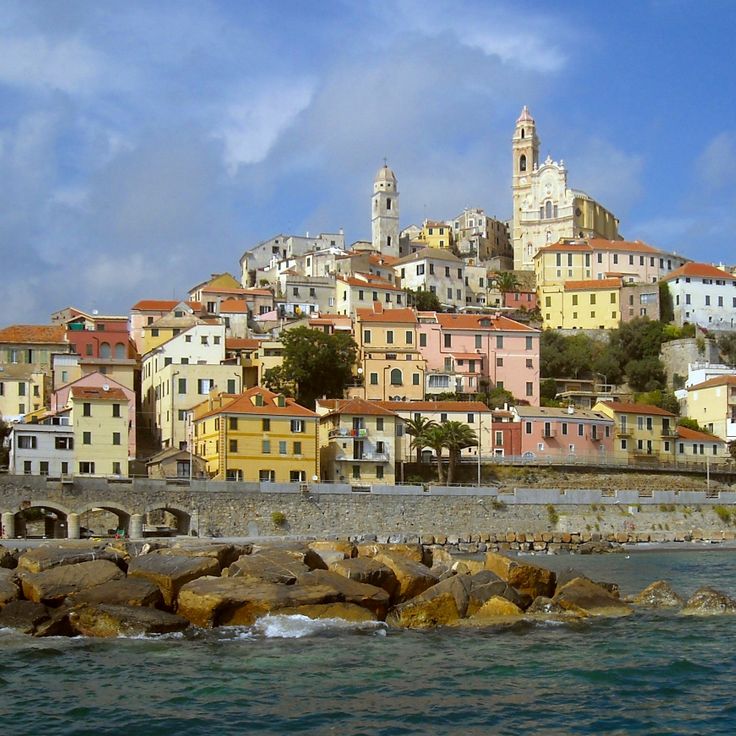
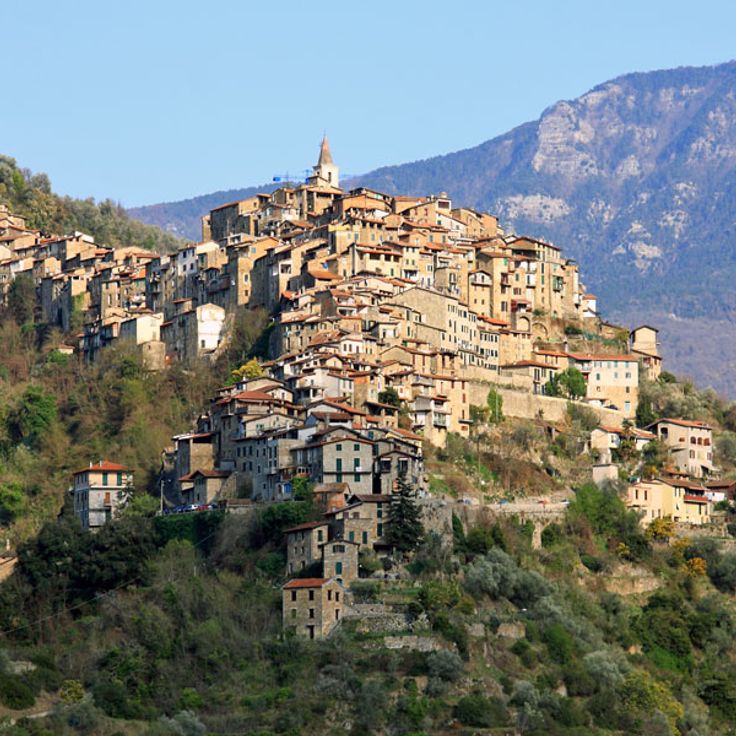
Inland valleys such as Valle Argentina lead to mountain villages that have maintained their historic architecture. Triora sits at 2,559 feet (780 meters) in the Ligurian Alps, Apricale displays stone alleys and vaulted passages, and Cervo perches above the coast between Imperia and Alassio. Bussana Vecchia was abandoned after an 1887 earthquake and later resettled by artists. Castelvecchio di Rocca Barbena clusters around a medieval fortress. The Grotte di Toirano and Borgio Verezzi Caves offer geological formations with stalactites and stalagmites. Montemarcello-Magra Regional Park extends between the coast at Montemarcello and the Magra Valley, while Palmaria Island lies off Portovenere with the Doria Tower. Genoa's Porto Antico connects the historic harbor with modern cultural facilities.
Liguria stretches as a narrow coastal strip between the Maritime Alps and the Apennines, combining maritime tradition with mountainous interior. Along the Riviera di Ponente in the west lie towns such as Dolceacqua with its medieval Doria Castle, the fortified town of Noli, and the Hanbury Botanical Gardens near La Mortola. The Riviera di Levante in the east features the Cinque Terre National Park with its coastal villages, Portofino with Castello Brown, and the Baia del Silenzio in Sestri Levante. Finalborgo preserves its medieval structure within the walls of Finale Ligure, while Vernazza with the Church of Santa Margherita d'Antiochia above the harbor belongs to the Cinque Terre.
Inland valleys such as Valle Argentina lead to mountain villages that have maintained their historic architecture. Triora sits at 2,559 feet (780 meters) in the Ligurian Alps, Apricale displays stone alleys and vaulted passages, and Cervo perches above the coast between Imperia and Alassio. Bussana Vecchia was abandoned after an 1887 earthquake and later resettled by artists. Castelvecchio di Rocca Barbena clusters around a medieval fortress. The Grotte di Toirano and Borgio Verezzi Caves offer geological formations with stalactites and stalagmites. Montemarcello-Magra Regional Park extends between the coast at Montemarcello and the Magra Valley, while Palmaria Island lies off Portovenere with the Doria Tower. Genoa's Porto Antico connects the historic harbor with modern cultural facilities.
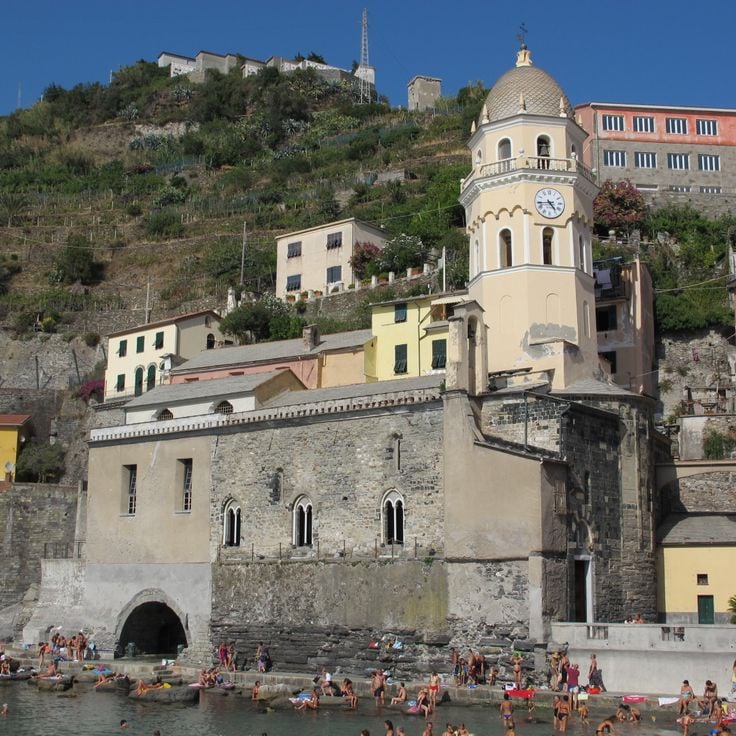
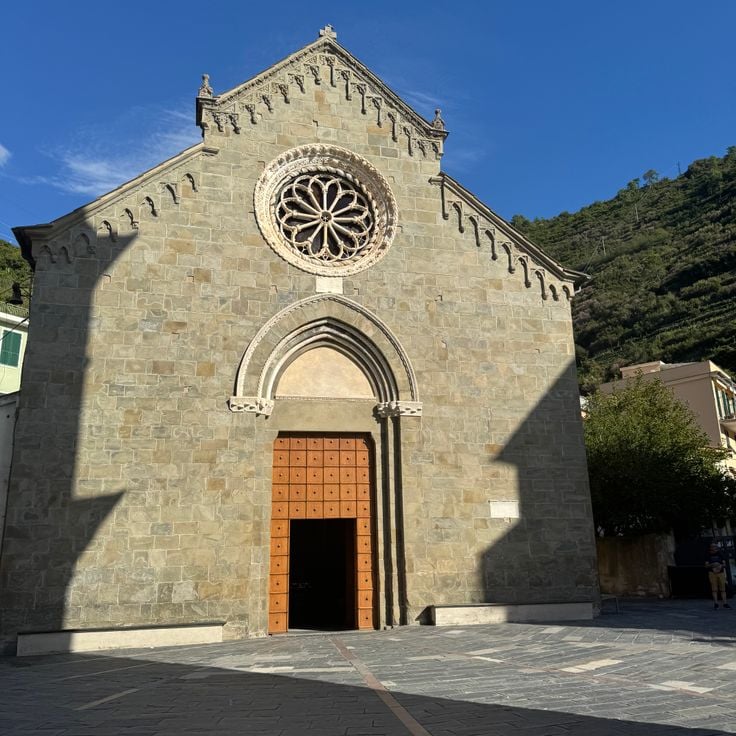
The Church of Santa Margherita d'Antiochia stands in Vernazza and combines maritime history with local architecture on the Ligurian coast. The church building dates from the 13th century and rises with its tower 131 feet (40 meters) above the sea. The construction shows an octagonal floor plan. The structure sits directly on the coast and represents an example of medieval religious architecture in this Ligurian coastal town between the French border and Tuscany.
Finalborgo is located inland from Finale Ligure and displays medieval structures from the 12th century. The stone walls enclose the historic center with four preserved entrance gates. Within the fortifications stand several churches and residential buildings from different periods. On the hill above the village rises Castel Gavone, a fortress complex of the Del Carretto family. The narrow lanes connect squares with arcades and historic facades. This village documents regional architecture between the Middle Ages and the Renaissance.
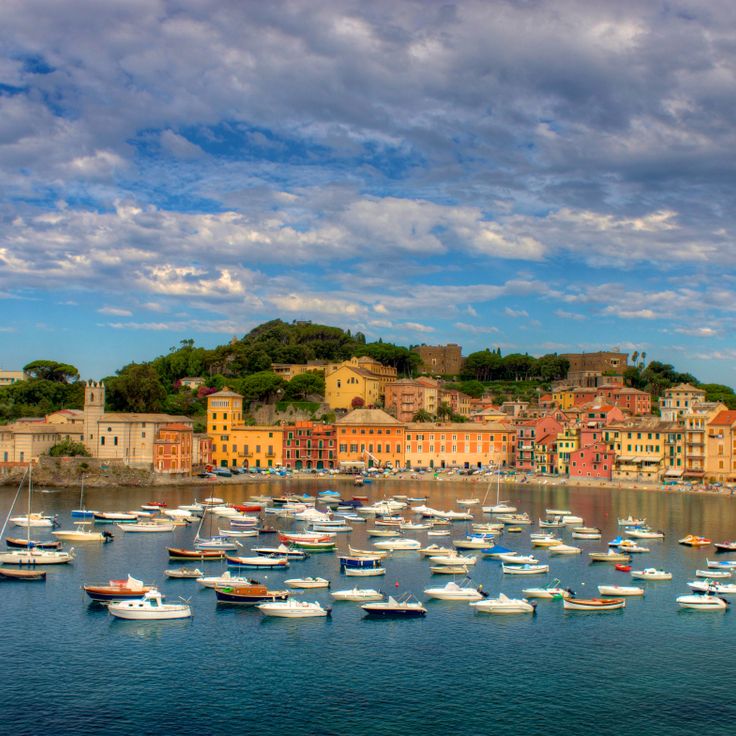
This bay in Sestri Levante extends about 300 feet (91 meters) along a fine sand beach. The shoreline is bordered by multistory residential buildings in yellow, pink, and orange tones that display the typical appearance of Ligurian coastal architecture. The sheltered location connects the maritime tradition of the town with historical construction from the 18th and 19th centuries. The bay forms a natural access to the sea and serves as a local bathing area.
Noli is a coastal town on the Ligurian Riviera with a Romanesque cathedral from the 12th century. The Castello di Monte Ursino from the 13th century sits on the hill of the same name above the old town. Medieval city walls and several defensive towers remain. The sandy beach extends along the bay. Narrow streets lead through the historic center to small squares. Noli was a maritime republic during the Middle Ages.
These botanical gardens extend across 44 acres (18 hectares) of steep terraces above the Ligurian coast and display a collection of Mediterranean and exotic plants. The grounds were established in the 19th century by the Hanbury family and preserve plant species from different climate zones. Pathways lead through landscaped areas with subtropical vegetation, palms, and succulents. The upper terraces provide views of the sea and the rocky coastline.
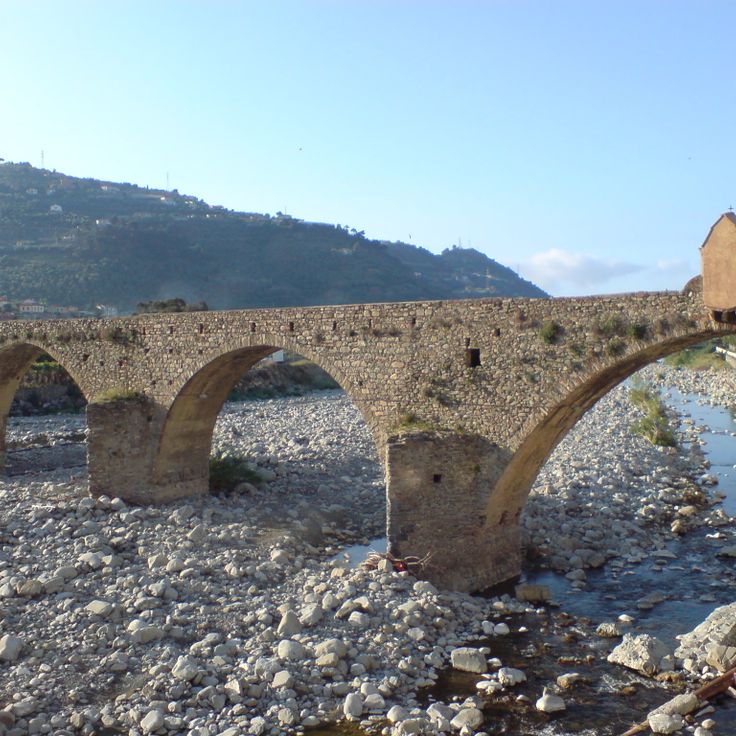
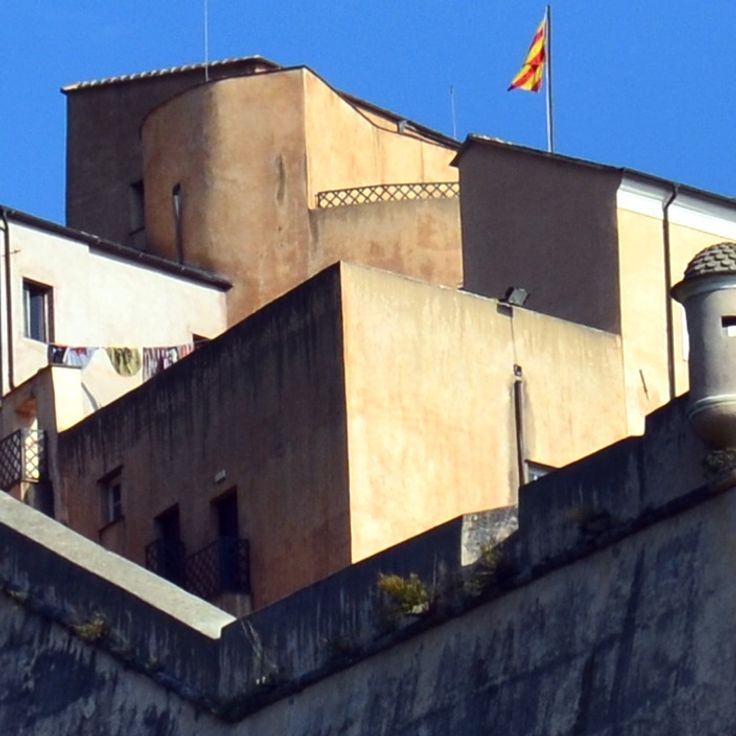
The Doria Castle rises above Dolceacqua as a medieval fortress from the 12th century. The structure includes several defensive towers, reinforced walls, and fortifications visible over the village rooftops and the stone bridge. This castle documents the military architecture of the Liguria region and shows the strategic importance of the location between the coast and the Alps. The construction combines Ligurian fortress traditions with the territorial claims of the Doria family.
Bussana Vecchia sits a few miles from Sanremo in the Ligurian interior. The village was destroyed by an earthquake in 1887, and its residents abandoned the site. In the 1960s, Italian and international artists settled among the ruins and established a community that continues today. The former church, crumbling stone houses, and narrow lanes define the village layout. Studios, galleries, and small workshops occupy spaces between restored buildings. This village connects the history of an earthquake site with the development of an artist colony.
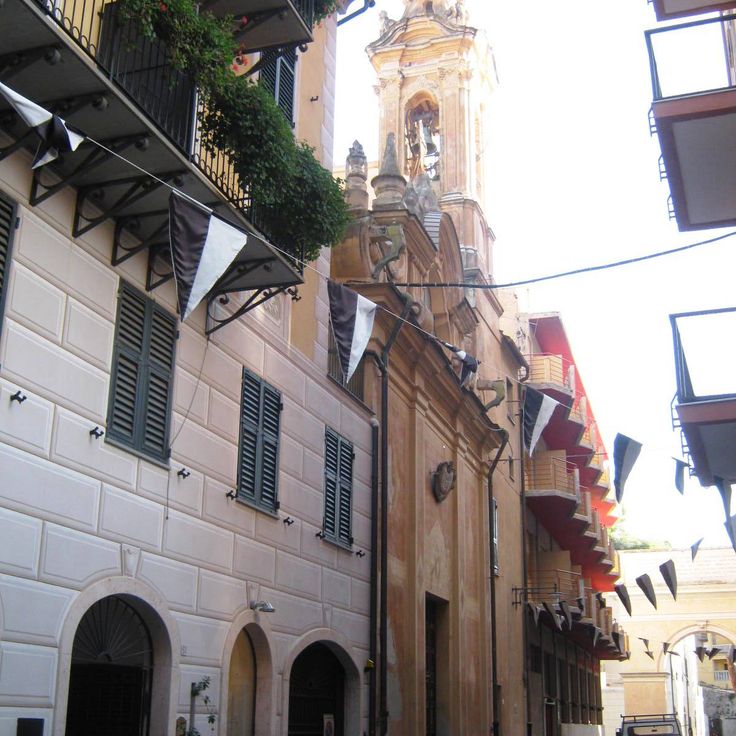
Cervo sits on the Ligurian coast between the French border and Tuscany and features a medieval core with stone houses from the 13th century. The Baroque church of San Giovanni Battista from the 17th century rises above the sea and contains paintings by regional artists. Narrow alleys lead from the harbor to the historic center, where residential buildings with arcades and vaults are located. The architecture combines maritime history with local building traditions and shows the transition from medieval village to Baroque coastal town.
Triora is a mountain village from the 13th century in the Ligurian Alps that preserves the history of medieval witch trials in the 16th century. Stone houses with slate roofs line narrow alleys with covered passages and archways. The Museum of Ethnography and Witchcraft documents the trials of 1587 to 1589 in historical rooms. The Church of San Bernardino from the 15th century displays Gothic construction elements, while the ruined castle above the village preserves remnants of medieval fortifications.
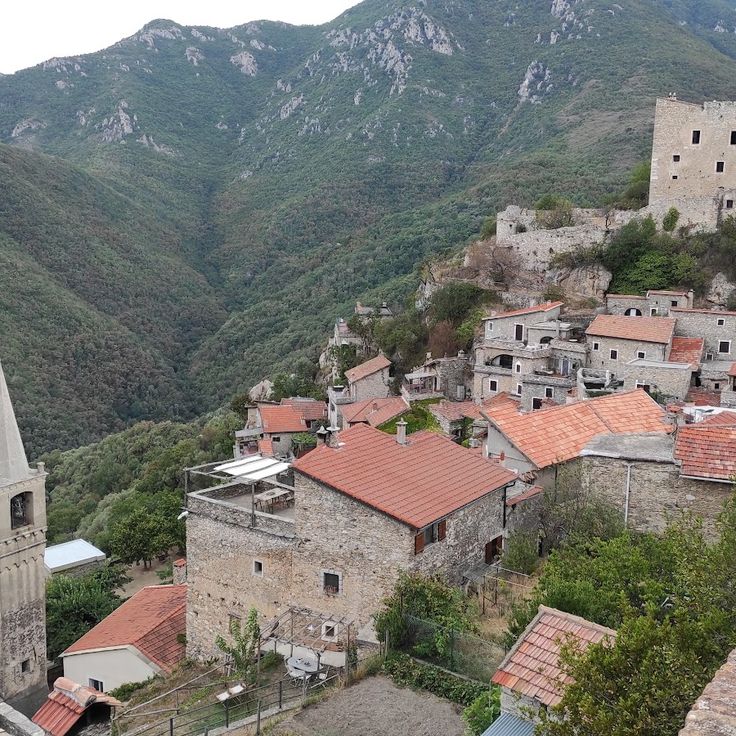
Apricale displays the medieval architecture of Ligurian mountain villages with structures built from local stone. The village sits on a hilltop in the Nervia Valley and contains the Castello della Lucertola from 1275, narrow cobblestone lanes, and traditional arcaded passages. The buildings date primarily from the 12th through 16th centuries and document regional stonemasonry techniques. From the elevated points, views extend over vineyards, olive groves, and the surrounding valleys between the coast and the Maritime Alps.
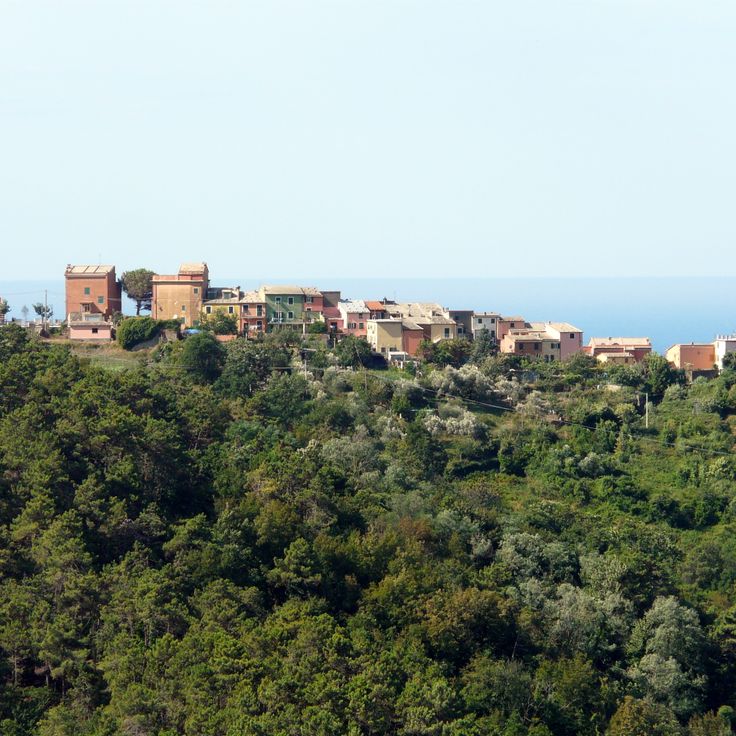
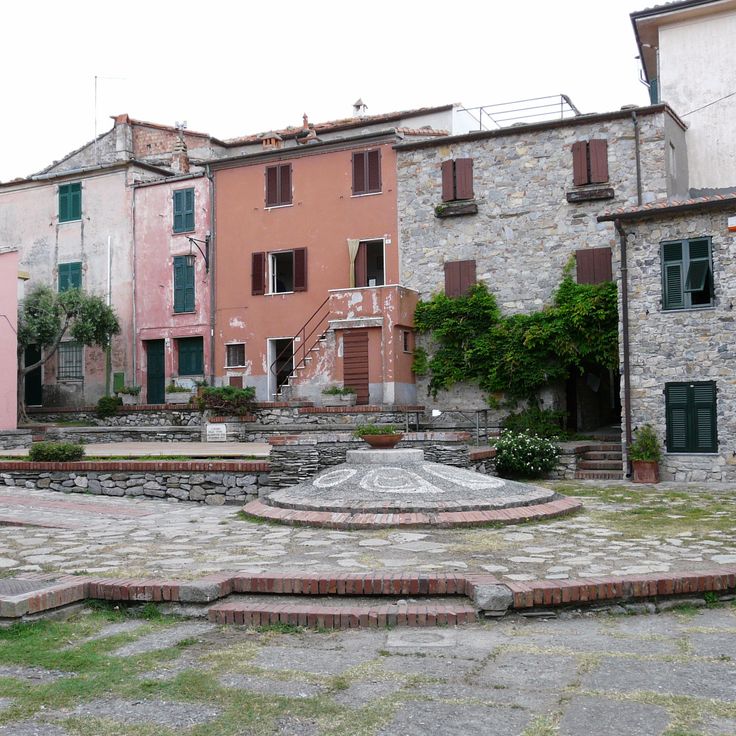
Framura spreads across five small villages along the Mediterranean slopes between Genoa and La Spezia. The individual hamlets connect through old pathways and stone staircases that wind between olive groves and the sea. The village shows the typical Ligurian settlement structure with houses built from local stone and narrow alleys. At the pebble beach below the settlement, coastal hiking trails converge. This community represents the historical construction methods of smaller Ligurian coastal villages that had to adapt to steep hillsides.
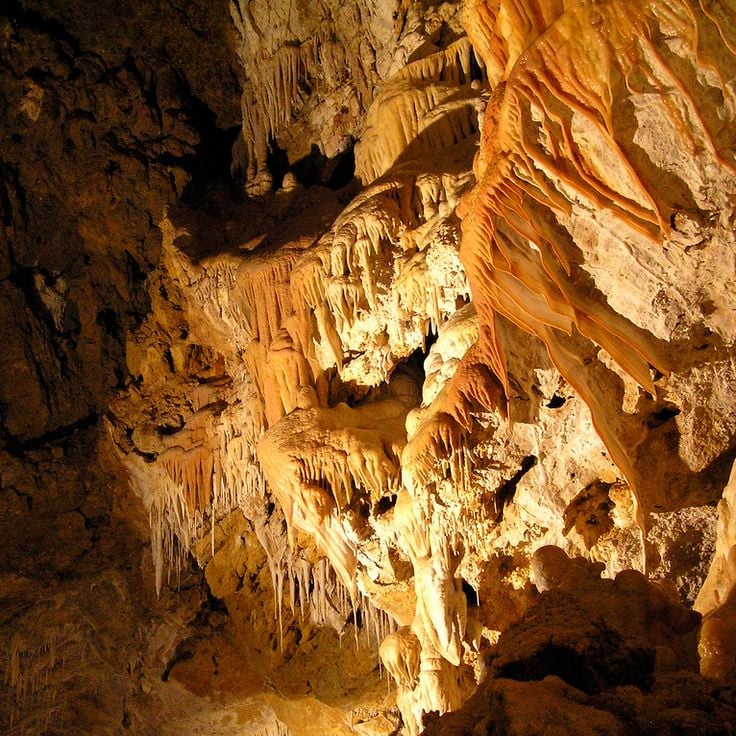
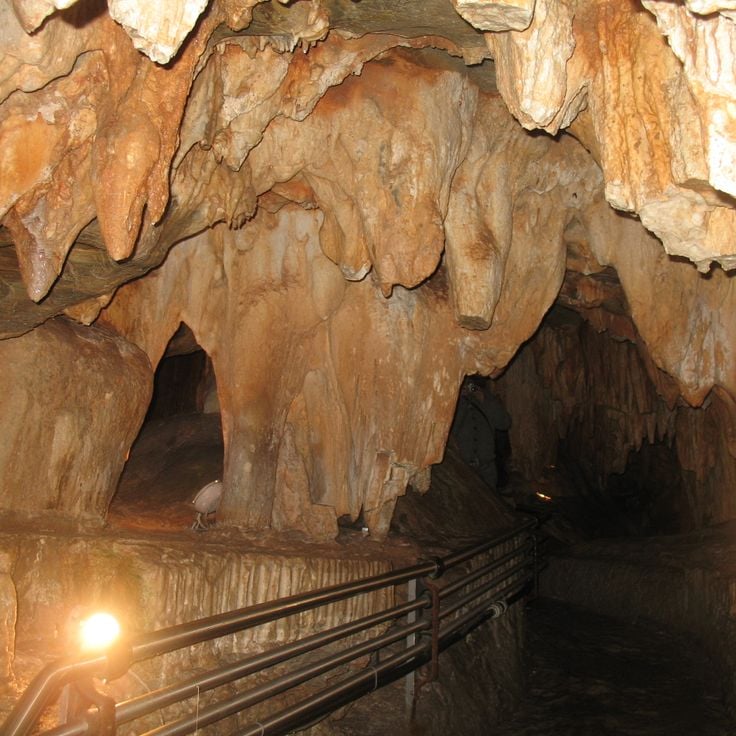
The Borgio Verezzi Caves are an underground limestone system on the Ligurian coast. The galleries formed over millions of years through natural dissolution processes and contain numerous mineral formations, including stalactites, stalagmites, and underground water pools. The system displays various geological formations and rock layers. Guided tours provide access to the illuminated sections of the cave system. The caves are located near the village of Borgio Verezzi between the French border and Tuscany, where the region combines maritime history with local architecture.
Montemarcello combines the maritime history of Liguria with the architecture of the hinterland as a medieval mountain village. Located at 1198 feet (365 meters) elevation, the village offers views over the Gulf of La Spezia, the coastline, and the Apuan Alps. Narrow lanes lead between historic stone houses to the twelfth-century Romanesque church of San Pietro. Hiking trails connect the village to surrounding vineyards and olive groves, as well as coastal paths in the Montemarcello-Magra-Vara Regional Park.
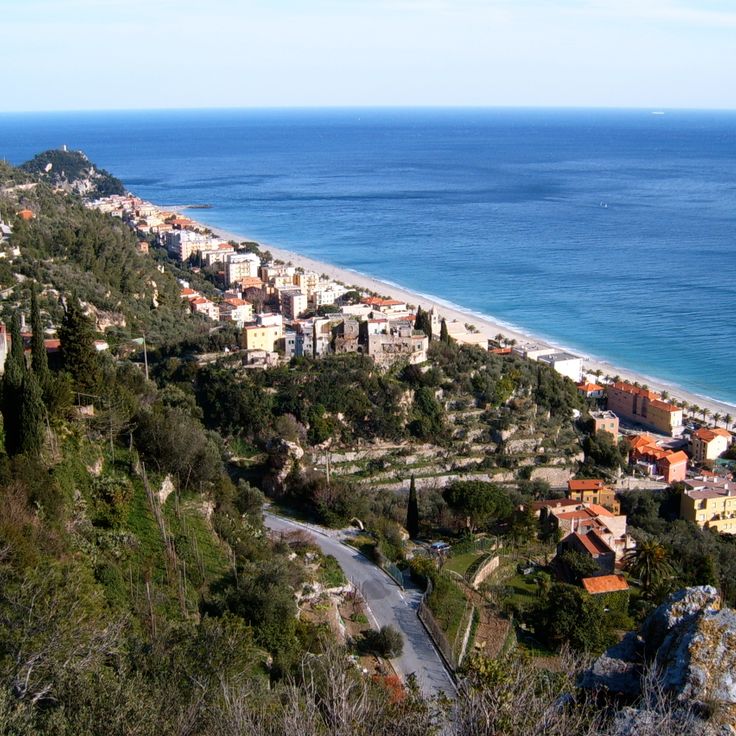
Varigotti is a coastal settlement on the Ligurian Riviera featuring pastel-colored houses along the waterfront promenade. The sandy beach extends between limestone cliffs and the sea. The village preserves its historic structure with narrow lanes between traditional fishermen's houses. The Saracen Bay at the eastern end marks the transition to the steep rock faces of the Malpasso cliff. The settlement combines its fishing harbor with characteristic buildings of Ligurian coastal architecture, demonstrating the typical settlement pattern of the region between sea and hinterland.
The Tower of the Four Songs stands in Portovenere as a stone defensive structure dating from 1536. This coastal tower served to monitor the Ligurian Sea and belongs to the examples of maritime defense architecture along the Ligurian coast. The structure documents the military history of the region between the French border and Tuscany, where port cities protected their coasts against attacks from the sea. The tower combines fortification architecture with the strategic importance of Portovenere.
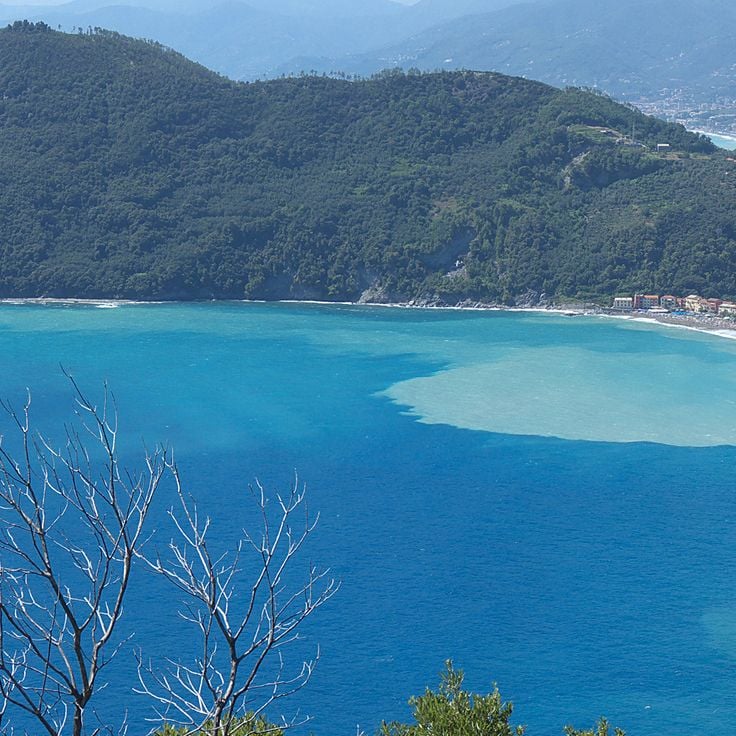
Punta Manara forms a forested promontory between Sestri Levante and Riva Trigoso on the Ligurian coast. This nature reserve preserves Mediterranean maquis vegetation and pine forests, through which marked trails lead to viewpoints over the sea. The coastal section displays typical formations of the Ligurian Riviera with rocky shores and small coves. The paths connect historic places in the region with the coastal landscape between the French border and Tuscany.
The Grotte di Toirano are among the notable caves in the Ligurian region, located in the hinterland near the coast. The cave system extends through several chambers with limestone formations displaying stalactites, stalagmites, and dripstone structures. Archaeological finds documented in the caves include traces of humans and animals from the Stone Age, along with bear impressions and footprints. The passages lead through different geological layers formed over thousands of years. Illuminated pathways provide access to the main areas of the cave system.
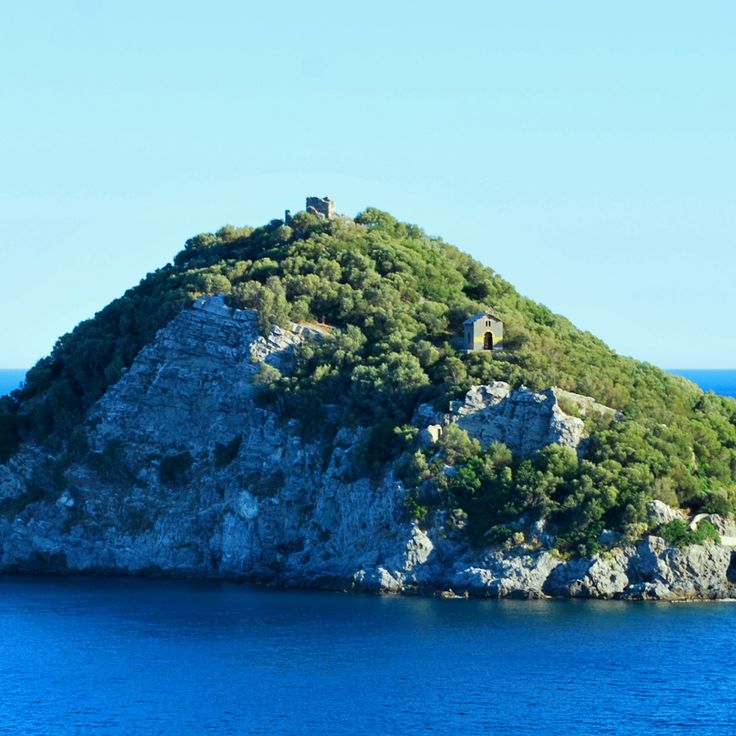
Bergeggi Island forms the center of a marine protected area off the Ligurian coast. The uninhabited island contains Mediterranean vegetation and remains of Roman structures from antiquity. Various fish species of the Mediterranean Sea inhabit the surrounding marine park. The island documents the historical importance of the Ligurian coast for maritime trade routes and illustrates the connection between natural environment and human settlement in the region.
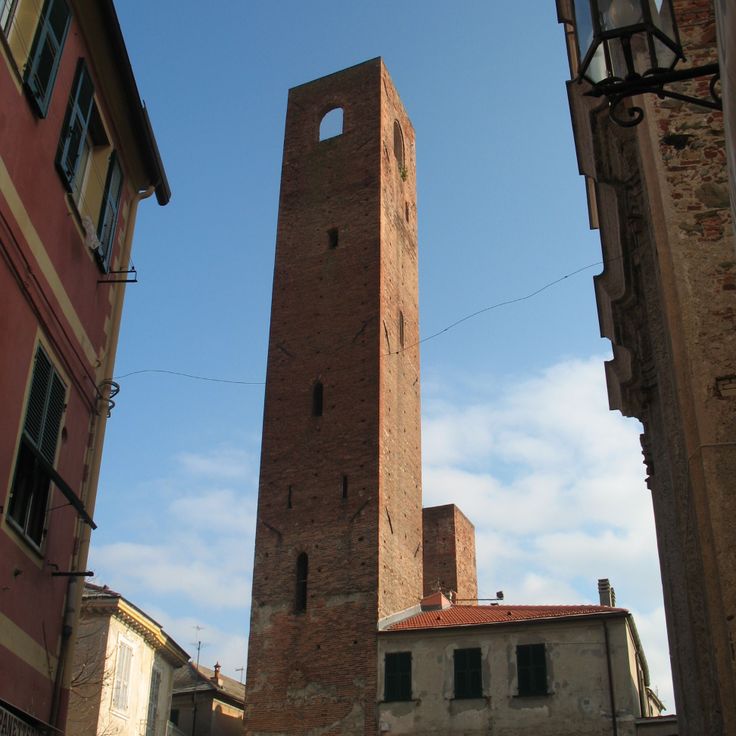
Brugnato displays its medieval character through narrow lanes and old stone structures in the Val di Vara. The 12th-century Romanesque cathedral forms the center of the town and preserves artworks from various periods. The adjoining museum of sacred art assembles liturgical objects and religious paintings from Ligurian churches. The town sits on historic pilgrimage routes and served for centuries as a trading point between the coast and the Apennines.
The Oratorio dei Neri in Imperia dates back to the 17th century and documents the Ligurian Baroque style of the region. The interior wall paintings and stucco work show the craftsmanship of this period. The building serves as an example of religious architecture on the Ligurian coast and complements the historical evidence between the French border and Tuscany with a structure that combines maritime history with local sacred architecture.
Montemarcello-Magra Regional Park extends along the Ligurian coast and the Magra River valley, preserving various Mediterranean plant species and historical evidence of ancient settlements. The protected area connects coastal hills with river floodplains and offers trails through holm oak forests, maquis vegetation, and to Roman excavation sites at Luni. The landscape shows the transition from the sea coast to the Apuan Alps and documents the connection between maritime and inland Liguria.
The Sanctuary of Our Lady of Soviore stands at 1,526 feet (465 meters) above Monterosso al Mare and counts among the significant pilgrimage sites in Liguria. The medieval complex includes a church with Gothic and Romanesque elements, pilgrim accommodations, and a detached bell tower. The structure combines religious architecture with the mountain landscape above the coast. Paths through vineyards and chestnut forests lead from the coast to this historic site.
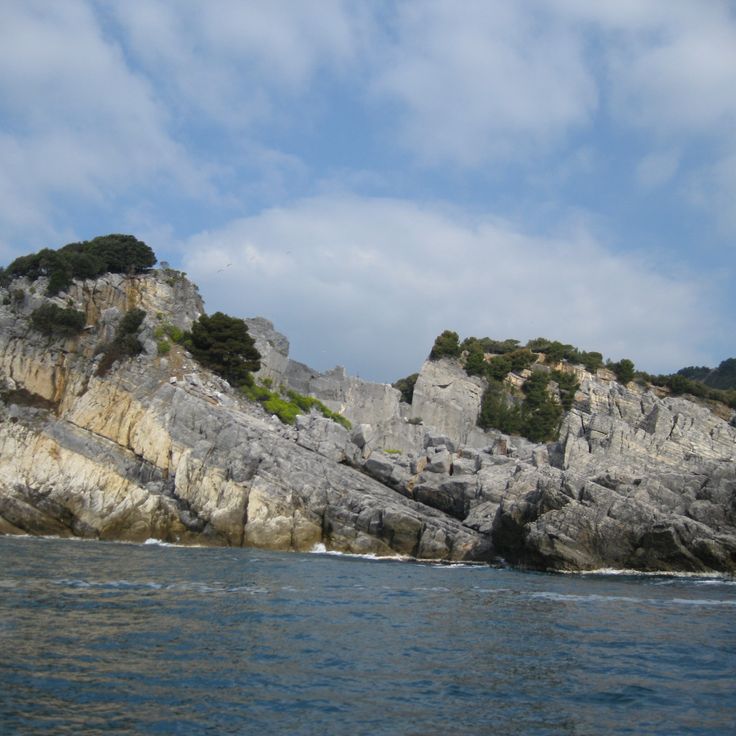
Palmaria Island off Portovenere displays Mediterranean vegetation and military fortifications from the 19th century that reflect the strategic importance of this coastal section. The nature reserve combines rocky cliffs with small coves along the shoreline. Hiking trails lead through maquis shrubland to the historic fortress structures. The island complements the medieval coastal towns of Liguria through its connection of natural landscape and military architecture. Several beaches provide access to the sea between the rock formations.
Castelvecchio di Rocca Barbena is a medieval village in the Ligurian interior, developed around an 11th-century castle. The fortress sits on a hill and documents the region's medieval military architecture. The narrow lanes of the village wind between stone houses, some of which retain their original structures. The castle served for centuries as a defensive stronghold of the Clavesana family and illustrates the strategic importance of this mountain position in medieval Liguria.
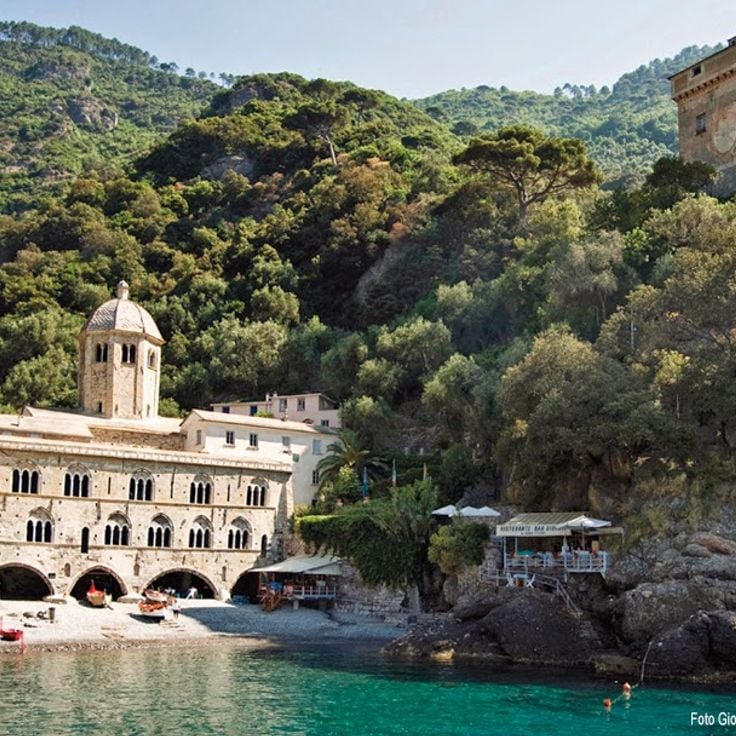
The Benedictine monastery of San Fruttuoso, dating from the 10th century, occupies a secluded cove between Camogli and Portofino and demonstrates centuries of Benedictine presence along the Ligurian coast. The complex includes a domed church with Gothic elements, a cloister, and several chapels that were expanded over the centuries. The Doria family used the monastery as their burial site from the 13th century onward, with tombs still visible in the lower church. The monastery is accessible only by hiking trails or by boat, as no road connects to the site. Offshore stands an underwater bronze statue of Christ of the Abyss, placed in 1954 as a memorial to divers who lost their lives.
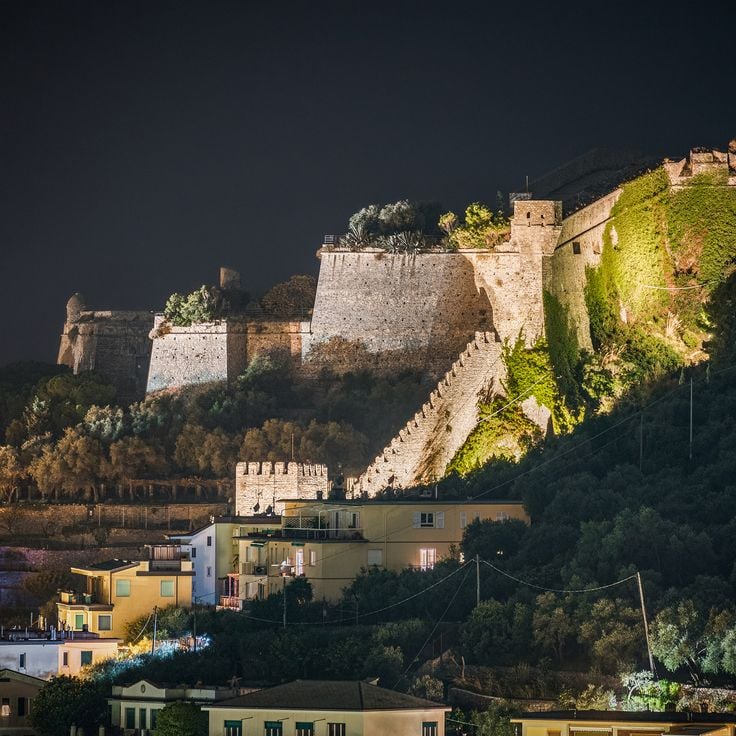
This 16th-century stone tower rises 115 feet (35 meters) above the cliffs of Porto Venere and served to monitor maritime traffic in the Gulf of La Spezia. The fortification was built under the rule of the Genoese Doria family and complemented the coastal defense system of the harbor town. From the upper floors of the tower, views extend across the Ligurian coastline and the offshore islands of Palmaria, Tino, and Tinetto. The massive stone walls and strategic position demonstrate Porto Venere's military importance in controlling sea routes between Genoa and Tuscany.
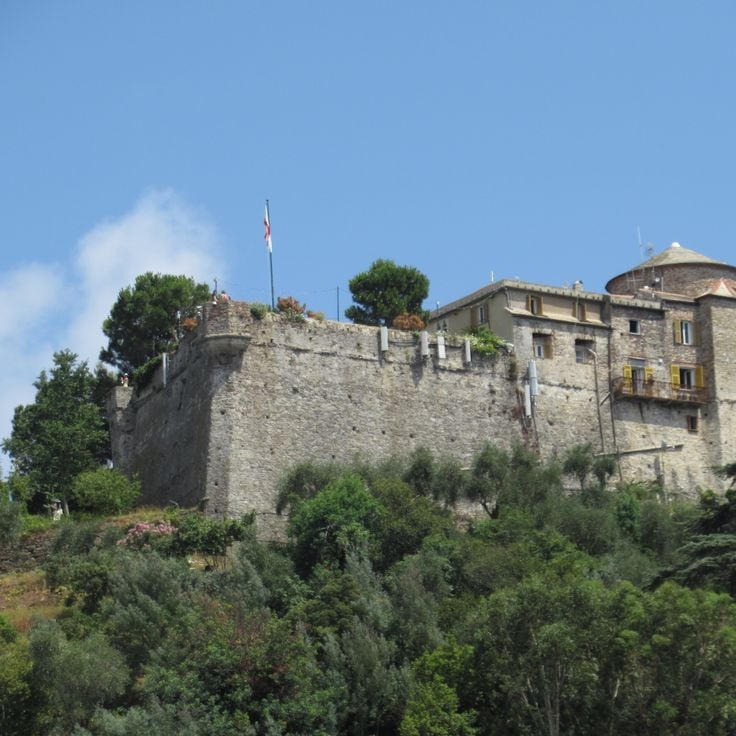
Castel Brown rises above the bay of Portofino and documents the military history of the Ligurian coast. The fortress was built in the 16th century to protect the harbor and was later converted into a private residence by British consul Montague Yeats Brown. Today the complex houses rotating art exhibitions and a museum dedicated to maritime history. The garden provides views over the Gulf of Tigullio and the surrounding hills. The ascent to the fortress follows a paved path through Mediterranean vegetation.
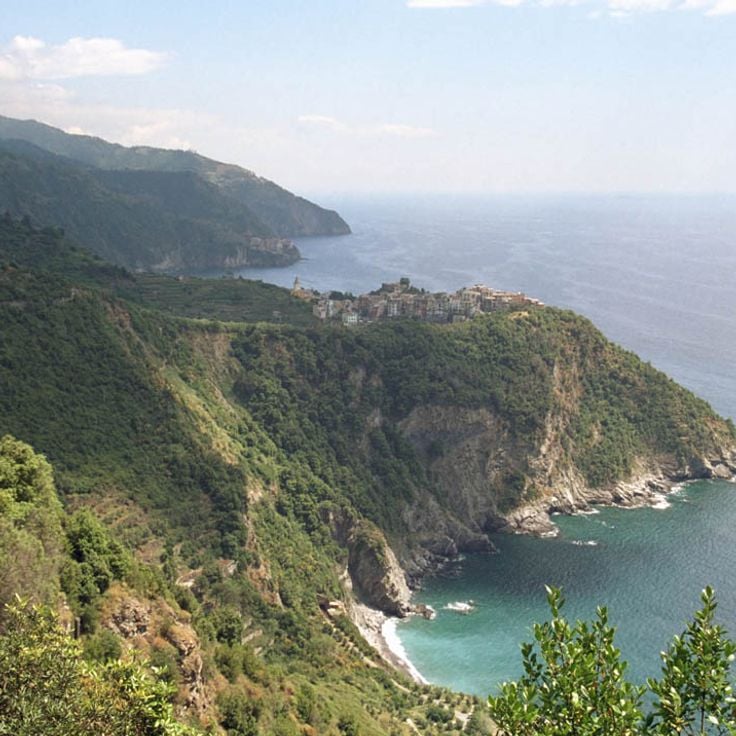
The Cinque Terre National Park covers 3,800 hectares (9,400 acres) along the Ligurian coast near La Spezia. The five historic villages of Monterosso al Mare, Vernazza, Corniglia, Manarola, and Riomaggiore stand between steep wine terraces and Mediterranean vegetation. The area displays traditional dry stone walls that have stabilized the slopes for centuries, along with hiking trails connecting the settlements. The park preserves the characteristic cultural landscape with olive groves, vineyards, and historic buildings that document the relationship between coastal location and mountain terrain.
This historic harbor area documents Genoa's maritime past as a major seafaring nation. Porto Antico combines several educational institutions and cultural sites along the waterfront. The aquarium houses Mediterranean and tropical marine life in large-format tanks. The maritime museum displays ship models, navigation instruments, and cartographic documents from various centuries. The children's science facility offers interactive exhibits on natural science and technology. Restaurants and cafés line the quaysides with direct harbor views.
The Altare Glass Museum documents the history of glassmaking in the mountains of Liguria. The collection displays historic tools, furnaces, and production methods from over three centuries of local craft tradition. Finished glass objects dating from 1700 onward illustrate the technical development from traditional handwork to industrial manufacturing. The museum is located in one of the historic mountain villages in the Ligurian hinterland.
Valle Argentina extends 25 miles (40 kilometers) through Imperia Province, connecting several medieval settlements with extensive olive groves. The valley features traditional stone houses, Romanesque church buildings, and terraced slopes used for olive cultivation for centuries. Numerous hiking trails access mountain villages along the river course, where local oil mills document regional production. The architecture of the settlements preserves medieval structures with narrow lanes and fortified cores.
The Church of Santa Margherita d'Antiochia stands in Vernazza and combines maritime history with local architecture on the Ligurian coast. The church building dates from the 13th century and rises with its tower 131 feet (40 meters) above the sea. The construction shows an octagonal floor plan. The structure sits directly on the coast and represents an example of medieval religious architecture in this Ligurian coastal town between the French border and Tuscany.
Finalborgo is located inland from Finale Ligure and displays medieval structures from the 12th century. The stone walls enclose the historic center with four preserved entrance gates. Within the fortifications stand several churches and residential buildings from different periods. On the hill above the village rises Castel Gavone, a fortress complex of the Del Carretto family. The narrow lanes connect squares with arcades and historic facades. This village documents regional architecture between the Middle Ages and the Renaissance.
This bay in Sestri Levante extends about 300 feet (91 meters) along a fine sand beach. The shoreline is bordered by multistory residential buildings in yellow, pink, and orange tones that display the typical appearance of Ligurian coastal architecture. The sheltered location connects the maritime tradition of the town with historical construction from the 18th and 19th centuries. The bay forms a natural access to the sea and serves as a local bathing area.
Noli is a coastal town on the Ligurian Riviera with a Romanesque cathedral from the 12th century. The Castello di Monte Ursino from the 13th century sits on the hill of the same name above the old town. Medieval city walls and several defensive towers remain. The sandy beach extends along the bay. Narrow streets lead through the historic center to small squares. Noli was a maritime republic during the Middle Ages.
These botanical gardens extend across 44 acres (18 hectares) of steep terraces above the Ligurian coast and display a collection of Mediterranean and exotic plants. The grounds were established in the 19th century by the Hanbury family and preserve plant species from different climate zones. Pathways lead through landscaped areas with subtropical vegetation, palms, and succulents. The upper terraces provide views of the sea and the rocky coastline.
The Doria Castle rises above Dolceacqua as a medieval fortress from the 12th century. The structure includes several defensive towers, reinforced walls, and fortifications visible over the village rooftops and the stone bridge. This castle documents the military architecture of the Liguria region and shows the strategic importance of the location between the coast and the Alps. The construction combines Ligurian fortress traditions with the territorial claims of the Doria family.
Bussana Vecchia sits a few miles from Sanremo in the Ligurian interior. The village was destroyed by an earthquake in 1887, and its residents abandoned the site. In the 1960s, Italian and international artists settled among the ruins and established a community that continues today. The former church, crumbling stone houses, and narrow lanes define the village layout. Studios, galleries, and small workshops occupy spaces between restored buildings. This village connects the history of an earthquake site with the development of an artist colony.
Cervo sits on the Ligurian coast between the French border and Tuscany and features a medieval core with stone houses from the 13th century. The Baroque church of San Giovanni Battista from the 17th century rises above the sea and contains paintings by regional artists. Narrow alleys lead from the harbor to the historic center, where residential buildings with arcades and vaults are located. The architecture combines maritime history with local building traditions and shows the transition from medieval village to Baroque coastal town.
Triora is a mountain village from the 13th century in the Ligurian Alps that preserves the history of medieval witch trials in the 16th century. Stone houses with slate roofs line narrow alleys with covered passages and archways. The Museum of Ethnography and Witchcraft documents the trials of 1587 to 1589 in historical rooms. The Church of San Bernardino from the 15th century displays Gothic construction elements, while the ruined castle above the village preserves remnants of medieval fortifications.
Apricale displays the medieval architecture of Ligurian mountain villages with structures built from local stone. The village sits on a hilltop in the Nervia Valley and contains the Castello della Lucertola from 1275, narrow cobblestone lanes, and traditional arcaded passages. The buildings date primarily from the 12th through 16th centuries and document regional stonemasonry techniques. From the elevated points, views extend over vineyards, olive groves, and the surrounding valleys between the coast and the Maritime Alps.
Framura spreads across five small villages along the Mediterranean slopes between Genoa and La Spezia. The individual hamlets connect through old pathways and stone staircases that wind between olive groves and the sea. The village shows the typical Ligurian settlement structure with houses built from local stone and narrow alleys. At the pebble beach below the settlement, coastal hiking trails converge. This community represents the historical construction methods of smaller Ligurian coastal villages that had to adapt to steep hillsides.
The Borgio Verezzi Caves are an underground limestone system on the Ligurian coast. The galleries formed over millions of years through natural dissolution processes and contain numerous mineral formations, including stalactites, stalagmites, and underground water pools. The system displays various geological formations and rock layers. Guided tours provide access to the illuminated sections of the cave system. The caves are located near the village of Borgio Verezzi between the French border and Tuscany, where the region combines maritime history with local architecture.
Montemarcello combines the maritime history of Liguria with the architecture of the hinterland as a medieval mountain village. Located at 1198 feet (365 meters) elevation, the village offers views over the Gulf of La Spezia, the coastline, and the Apuan Alps. Narrow lanes lead between historic stone houses to the twelfth-century Romanesque church of San Pietro. Hiking trails connect the village to surrounding vineyards and olive groves, as well as coastal paths in the Montemarcello-Magra-Vara Regional Park.
Varigotti is a coastal settlement on the Ligurian Riviera featuring pastel-colored houses along the waterfront promenade. The sandy beach extends between limestone cliffs and the sea. The village preserves its historic structure with narrow lanes between traditional fishermen's houses. The Saracen Bay at the eastern end marks the transition to the steep rock faces of the Malpasso cliff. The settlement combines its fishing harbor with characteristic buildings of Ligurian coastal architecture, demonstrating the typical settlement pattern of the region between sea and hinterland.
The Tower of the Four Songs stands in Portovenere as a stone defensive structure dating from 1536. This coastal tower served to monitor the Ligurian Sea and belongs to the examples of maritime defense architecture along the Ligurian coast. The structure documents the military history of the region between the French border and Tuscany, where port cities protected their coasts against attacks from the sea. The tower combines fortification architecture with the strategic importance of Portovenere.
Punta Manara forms a forested promontory between Sestri Levante and Riva Trigoso on the Ligurian coast. This nature reserve preserves Mediterranean maquis vegetation and pine forests, through which marked trails lead to viewpoints over the sea. The coastal section displays typical formations of the Ligurian Riviera with rocky shores and small coves. The paths connect historic places in the region with the coastal landscape between the French border and Tuscany.
The Grotte di Toirano are among the notable caves in the Ligurian region, located in the hinterland near the coast. The cave system extends through several chambers with limestone formations displaying stalactites, stalagmites, and dripstone structures. Archaeological finds documented in the caves include traces of humans and animals from the Stone Age, along with bear impressions and footprints. The passages lead through different geological layers formed over thousands of years. Illuminated pathways provide access to the main areas of the cave system.
Bergeggi Island forms the center of a marine protected area off the Ligurian coast. The uninhabited island contains Mediterranean vegetation and remains of Roman structures from antiquity. Various fish species of the Mediterranean Sea inhabit the surrounding marine park. The island documents the historical importance of the Ligurian coast for maritime trade routes and illustrates the connection between natural environment and human settlement in the region.
Brugnato displays its medieval character through narrow lanes and old stone structures in the Val di Vara. The 12th-century Romanesque cathedral forms the center of the town and preserves artworks from various periods. The adjoining museum of sacred art assembles liturgical objects and religious paintings from Ligurian churches. The town sits on historic pilgrimage routes and served for centuries as a trading point between the coast and the Apennines.
The Oratorio dei Neri in Imperia dates back to the 17th century and documents the Ligurian Baroque style of the region. The interior wall paintings and stucco work show the craftsmanship of this period. The building serves as an example of religious architecture on the Ligurian coast and complements the historical evidence between the French border and Tuscany with a structure that combines maritime history with local sacred architecture.
Montemarcello-Magra Regional Park extends along the Ligurian coast and the Magra River valley, preserving various Mediterranean plant species and historical evidence of ancient settlements. The protected area connects coastal hills with river floodplains and offers trails through holm oak forests, maquis vegetation, and to Roman excavation sites at Luni. The landscape shows the transition from the sea coast to the Apuan Alps and documents the connection between maritime and inland Liguria.
The Sanctuary of Our Lady of Soviore stands at 1,526 feet (465 meters) above Monterosso al Mare and counts among the significant pilgrimage sites in Liguria. The medieval complex includes a church with Gothic and Romanesque elements, pilgrim accommodations, and a detached bell tower. The structure combines religious architecture with the mountain landscape above the coast. Paths through vineyards and chestnut forests lead from the coast to this historic site.
Palmaria Island off Portovenere displays Mediterranean vegetation and military fortifications from the 19th century that reflect the strategic importance of this coastal section. The nature reserve combines rocky cliffs with small coves along the shoreline. Hiking trails lead through maquis shrubland to the historic fortress structures. The island complements the medieval coastal towns of Liguria through its connection of natural landscape and military architecture. Several beaches provide access to the sea between the rock formations.
Castelvecchio di Rocca Barbena is a medieval village in the Ligurian interior, developed around an 11th-century castle. The fortress sits on a hill and documents the region's medieval military architecture. The narrow lanes of the village wind between stone houses, some of which retain their original structures. The castle served for centuries as a defensive stronghold of the Clavesana family and illustrates the strategic importance of this mountain position in medieval Liguria.
The Benedictine monastery of San Fruttuoso, dating from the 10th century, occupies a secluded cove between Camogli and Portofino and demonstrates centuries of Benedictine presence along the Ligurian coast. The complex includes a domed church with Gothic elements, a cloister, and several chapels that were expanded over the centuries. The Doria family used the monastery as their burial site from the 13th century onward, with tombs still visible in the lower church. The monastery is accessible only by hiking trails or by boat, as no road connects to the site. Offshore stands an underwater bronze statue of Christ of the Abyss, placed in 1954 as a memorial to divers who lost their lives.
This 16th-century stone tower rises 115 feet (35 meters) above the cliffs of Porto Venere and served to monitor maritime traffic in the Gulf of La Spezia. The fortification was built under the rule of the Genoese Doria family and complemented the coastal defense system of the harbor town. From the upper floors of the tower, views extend across the Ligurian coastline and the offshore islands of Palmaria, Tino, and Tinetto. The massive stone walls and strategic position demonstrate Porto Venere's military importance in controlling sea routes between Genoa and Tuscany.
Castel Brown rises above the bay of Portofino and documents the military history of the Ligurian coast. The fortress was built in the 16th century to protect the harbor and was later converted into a private residence by British consul Montague Yeats Brown. Today the complex houses rotating art exhibitions and a museum dedicated to maritime history. The garden provides views over the Gulf of Tigullio and the surrounding hills. The ascent to the fortress follows a paved path through Mediterranean vegetation.
The Cinque Terre National Park covers 3,800 hectares (9,400 acres) along the Ligurian coast near La Spezia. The five historic villages of Monterosso al Mare, Vernazza, Corniglia, Manarola, and Riomaggiore stand between steep wine terraces and Mediterranean vegetation. The area displays traditional dry stone walls that have stabilized the slopes for centuries, along with hiking trails connecting the settlements. The park preserves the characteristic cultural landscape with olive groves, vineyards, and historic buildings that document the relationship between coastal location and mountain terrain.
This historic harbor area documents Genoa's maritime past as a major seafaring nation. Porto Antico combines several educational institutions and cultural sites along the waterfront. The aquarium houses Mediterranean and tropical marine life in large-format tanks. The maritime museum displays ship models, navigation instruments, and cartographic documents from various centuries. The children's science facility offers interactive exhibits on natural science and technology. Restaurants and cafés line the quaysides with direct harbor views.
The Altare Glass Museum documents the history of glassmaking in the mountains of Liguria. The collection displays historic tools, furnaces, and production methods from over three centuries of local craft tradition. Finished glass objects dating from 1700 onward illustrate the technical development from traditional handwork to industrial manufacturing. The museum is located in one of the historic mountain villages in the Ligurian hinterland.
Valle Argentina extends 25 miles (40 kilometers) through Imperia Province, connecting several medieval settlements with extensive olive groves. The valley features traditional stone houses, Romanesque church buildings, and terraced slopes used for olive cultivation for centuries. Numerous hiking trails access mountain villages along the river course, where local oil mills document regional production. The architecture of the settlements preserves medieval structures with narrow lanes and fortified cores.
The Church of Santa Margherita d'Antiochia stands in Vernazza and combines maritime history with local architecture on the Ligurian coast. The church building dates from the 13th century and rises with its tower 131 feet (40 meters) above the sea. The construction shows an octagonal floor plan. The structure sits directly on the coast and represents an example of medieval religious architecture in this Ligurian coastal town between the French border and Tuscany.
Finalborgo is located inland from Finale Ligure and displays medieval structures from the 12th century. The stone walls enclose the historic center with four preserved entrance gates. Within the fortifications stand several churches and residential buildings from different periods. On the hill above the village rises Castel Gavone, a fortress complex of the Del Carretto family. The narrow lanes connect squares with arcades and historic facades. This village documents regional architecture between the Middle Ages and the Renaissance.
This bay in Sestri Levante extends about 300 feet (91 meters) along a fine sand beach. The shoreline is bordered by multistory residential buildings in yellow, pink, and orange tones that display the typical appearance of Ligurian coastal architecture. The sheltered location connects the maritime tradition of the town with historical construction from the 18th and 19th centuries. The bay forms a natural access to the sea and serves as a local bathing area.
Noli is a coastal town on the Ligurian Riviera with a Romanesque cathedral from the 12th century. The Castello di Monte Ursino from the 13th century sits on the hill of the same name above the old town. Medieval city walls and several defensive towers remain. The sandy beach extends along the bay. Narrow streets lead through the historic center to small squares. Noli was a maritime republic during the Middle Ages.
These botanical gardens extend across 44 acres (18 hectares) of steep terraces above the Ligurian coast and display a collection of Mediterranean and exotic plants. The grounds were established in the 19th century by the Hanbury family and preserve plant species from different climate zones. Pathways lead through landscaped areas with subtropical vegetation, palms, and succulents. The upper terraces provide views of the sea and the rocky coastline.
The Doria Castle rises above Dolceacqua as a medieval fortress from the 12th century. The structure includes several defensive towers, reinforced walls, and fortifications visible over the village rooftops and the stone bridge. This castle documents the military architecture of the Liguria region and shows the strategic importance of the location between the coast and the Alps. The construction combines Ligurian fortress traditions with the territorial claims of the Doria family.
Bussana Vecchia sits a few miles from Sanremo in the Ligurian interior. The village was destroyed by an earthquake in 1887, and its residents abandoned the site. In the 1960s, Italian and international artists settled among the ruins and established a community that continues today. The former church, crumbling stone houses, and narrow lanes define the village layout. Studios, galleries, and small workshops occupy spaces between restored buildings. This village connects the history of an earthquake site with the development of an artist colony.
Cervo sits on the Ligurian coast between the French border and Tuscany and features a medieval core with stone houses from the 13th century. The Baroque church of San Giovanni Battista from the 17th century rises above the sea and contains paintings by regional artists. Narrow alleys lead from the harbor to the historic center, where residential buildings with arcades and vaults are located. The architecture combines maritime history with local building traditions and shows the transition from medieval village to Baroque coastal town.
Triora is a mountain village from the 13th century in the Ligurian Alps that preserves the history of medieval witch trials in the 16th century. Stone houses with slate roofs line narrow alleys with covered passages and archways. The Museum of Ethnography and Witchcraft documents the trials of 1587 to 1589 in historical rooms. The Church of San Bernardino from the 15th century displays Gothic construction elements, while the ruined castle above the village preserves remnants of medieval fortifications.
Apricale displays the medieval architecture of Ligurian mountain villages with structures built from local stone. The village sits on a hilltop in the Nervia Valley and contains the Castello della Lucertola from 1275, narrow cobblestone lanes, and traditional arcaded passages. The buildings date primarily from the 12th through 16th centuries and document regional stonemasonry techniques. From the elevated points, views extend over vineyards, olive groves, and the surrounding valleys between the coast and the Maritime Alps.
Framura spreads across five small villages along the Mediterranean slopes between Genoa and La Spezia. The individual hamlets connect through old pathways and stone staircases that wind between olive groves and the sea. The village shows the typical Ligurian settlement structure with houses built from local stone and narrow alleys. At the pebble beach below the settlement, coastal hiking trails converge. This community represents the historical construction methods of smaller Ligurian coastal villages that had to adapt to steep hillsides.
The Borgio Verezzi Caves are an underground limestone system on the Ligurian coast. The galleries formed over millions of years through natural dissolution processes and contain numerous mineral formations, including stalactites, stalagmites, and underground water pools. The system displays various geological formations and rock layers. Guided tours provide access to the illuminated sections of the cave system. The caves are located near the village of Borgio Verezzi between the French border and Tuscany, where the region combines maritime history with local architecture.
Montemarcello combines the maritime history of Liguria with the architecture of the hinterland as a medieval mountain village. Located at 1198 feet (365 meters) elevation, the village offers views over the Gulf of La Spezia, the coastline, and the Apuan Alps. Narrow lanes lead between historic stone houses to the twelfth-century Romanesque church of San Pietro. Hiking trails connect the village to surrounding vineyards and olive groves, as well as coastal paths in the Montemarcello-Magra-Vara Regional Park.
Varigotti is a coastal settlement on the Ligurian Riviera featuring pastel-colored houses along the waterfront promenade. The sandy beach extends between limestone cliffs and the sea. The village preserves its historic structure with narrow lanes between traditional fishermen's houses. The Saracen Bay at the eastern end marks the transition to the steep rock faces of the Malpasso cliff. The settlement combines its fishing harbor with characteristic buildings of Ligurian coastal architecture, demonstrating the typical settlement pattern of the region between sea and hinterland.
The Tower of the Four Songs stands in Portovenere as a stone defensive structure dating from 1536. This coastal tower served to monitor the Ligurian Sea and belongs to the examples of maritime defense architecture along the Ligurian coast. The structure documents the military history of the region between the French border and Tuscany, where port cities protected their coasts against attacks from the sea. The tower combines fortification architecture with the strategic importance of Portovenere.
Punta Manara forms a forested promontory between Sestri Levante and Riva Trigoso on the Ligurian coast. This nature reserve preserves Mediterranean maquis vegetation and pine forests, through which marked trails lead to viewpoints over the sea. The coastal section displays typical formations of the Ligurian Riviera with rocky shores and small coves. The paths connect historic places in the region with the coastal landscape between the French border and Tuscany.
The Grotte di Toirano are among the notable caves in the Ligurian region, located in the hinterland near the coast. The cave system extends through several chambers with limestone formations displaying stalactites, stalagmites, and dripstone structures. Archaeological finds documented in the caves include traces of humans and animals from the Stone Age, along with bear impressions and footprints. The passages lead through different geological layers formed over thousands of years. Illuminated pathways provide access to the main areas of the cave system.
Bergeggi Island forms the center of a marine protected area off the Ligurian coast. The uninhabited island contains Mediterranean vegetation and remains of Roman structures from antiquity. Various fish species of the Mediterranean Sea inhabit the surrounding marine park. The island documents the historical importance of the Ligurian coast for maritime trade routes and illustrates the connection between natural environment and human settlement in the region.
Brugnato displays its medieval character through narrow lanes and old stone structures in the Val di Vara. The 12th-century Romanesque cathedral forms the center of the town and preserves artworks from various periods. The adjoining museum of sacred art assembles liturgical objects and religious paintings from Ligurian churches. The town sits on historic pilgrimage routes and served for centuries as a trading point between the coast and the Apennines.
The Oratorio dei Neri in Imperia dates back to the 17th century and documents the Ligurian Baroque style of the region. The interior wall paintings and stucco work show the craftsmanship of this period. The building serves as an example of religious architecture on the Ligurian coast and complements the historical evidence between the French border and Tuscany with a structure that combines maritime history with local sacred architecture.
Montemarcello-Magra Regional Park extends along the Ligurian coast and the Magra River valley, preserving various Mediterranean plant species and historical evidence of ancient settlements. The protected area connects coastal hills with river floodplains and offers trails through holm oak forests, maquis vegetation, and to Roman excavation sites at Luni. The landscape shows the transition from the sea coast to the Apuan Alps and documents the connection between maritime and inland Liguria.
The Sanctuary of Our Lady of Soviore stands at 1,526 feet (465 meters) above Monterosso al Mare and counts among the significant pilgrimage sites in Liguria. The medieval complex includes a church with Gothic and Romanesque elements, pilgrim accommodations, and a detached bell tower. The structure combines religious architecture with the mountain landscape above the coast. Paths through vineyards and chestnut forests lead from the coast to this historic site.
Palmaria Island off Portovenere displays Mediterranean vegetation and military fortifications from the 19th century that reflect the strategic importance of this coastal section. The nature reserve combines rocky cliffs with small coves along the shoreline. Hiking trails lead through maquis shrubland to the historic fortress structures. The island complements the medieval coastal towns of Liguria through its connection of natural landscape and military architecture. Several beaches provide access to the sea between the rock formations.
Castelvecchio di Rocca Barbena is a medieval village in the Ligurian interior, developed around an 11th-century castle. The fortress sits on a hill and documents the region's medieval military architecture. The narrow lanes of the village wind between stone houses, some of which retain their original structures. The castle served for centuries as a defensive stronghold of the Clavesana family and illustrates the strategic importance of this mountain position in medieval Liguria.
The Benedictine monastery of San Fruttuoso, dating from the 10th century, occupies a secluded cove between Camogli and Portofino and demonstrates centuries of Benedictine presence along the Ligurian coast. The complex includes a domed church with Gothic elements, a cloister, and several chapels that were expanded over the centuries. The Doria family used the monastery as their burial site from the 13th century onward, with tombs still visible in the lower church. The monastery is accessible only by hiking trails or by boat, as no road connects to the site. Offshore stands an underwater bronze statue of Christ of the Abyss, placed in 1954 as a memorial to divers who lost their lives.
This 16th-century stone tower rises 115 feet (35 meters) above the cliffs of Porto Venere and served to monitor maritime traffic in the Gulf of La Spezia. The fortification was built under the rule of the Genoese Doria family and complemented the coastal defense system of the harbor town. From the upper floors of the tower, views extend across the Ligurian coastline and the offshore islands of Palmaria, Tino, and Tinetto. The massive stone walls and strategic position demonstrate Porto Venere's military importance in controlling sea routes between Genoa and Tuscany.
Castel Brown rises above the bay of Portofino and documents the military history of the Ligurian coast. The fortress was built in the 16th century to protect the harbor and was later converted into a private residence by British consul Montague Yeats Brown. Today the complex houses rotating art exhibitions and a museum dedicated to maritime history. The garden provides views over the Gulf of Tigullio and the surrounding hills. The ascent to the fortress follows a paved path through Mediterranean vegetation.
The Cinque Terre National Park covers 3,800 hectares (9,400 acres) along the Ligurian coast near La Spezia. The five historic villages of Monterosso al Mare, Vernazza, Corniglia, Manarola, and Riomaggiore stand between steep wine terraces and Mediterranean vegetation. The area displays traditional dry stone walls that have stabilized the slopes for centuries, along with hiking trails connecting the settlements. The park preserves the characteristic cultural landscape with olive groves, vineyards, and historic buildings that document the relationship between coastal location and mountain terrain.
This historic harbor area documents Genoa's maritime past as a major seafaring nation. Porto Antico combines several educational institutions and cultural sites along the waterfront. The aquarium houses Mediterranean and tropical marine life in large-format tanks. The maritime museum displays ship models, navigation instruments, and cartographic documents from various centuries. The children's science facility offers interactive exhibits on natural science and technology. Restaurants and cafés line the quaysides with direct harbor views.
The Altare Glass Museum documents the history of glassmaking in the mountains of Liguria. The collection displays historic tools, furnaces, and production methods from over three centuries of local craft tradition. Finished glass objects dating from 1700 onward illustrate the technical development from traditional handwork to industrial manufacturing. The museum is located in one of the historic mountain villages in the Ligurian hinterland.
Valle Argentina extends 25 miles (40 kilometers) through Imperia Province, connecting several medieval settlements with extensive olive groves. The valley features traditional stone houses, Romanesque church buildings, and terraced slopes used for olive cultivation for centuries. Numerous hiking trails access mountain villages along the river course, where local oil mills document regional production. The architecture of the settlements preserves medieval structures with narrow lanes and fortified cores.