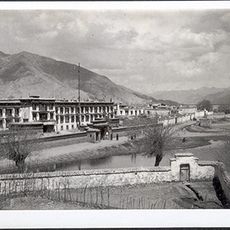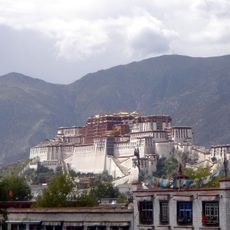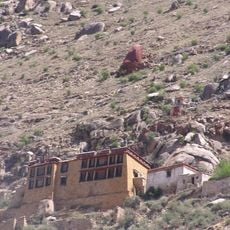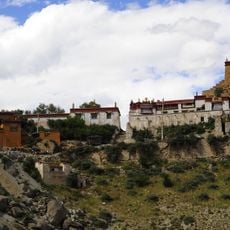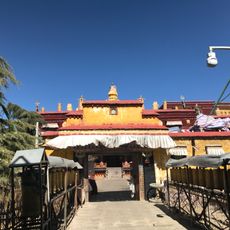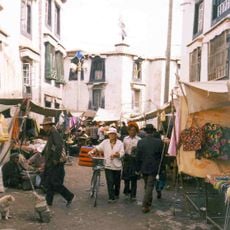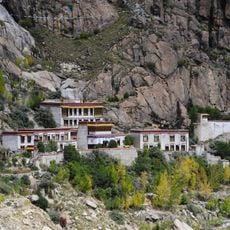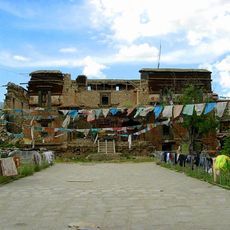
Yerpa monastery, Buddhist monastery in Dagzê District, China.
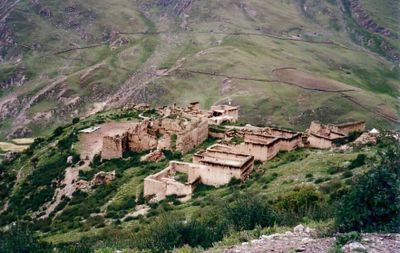
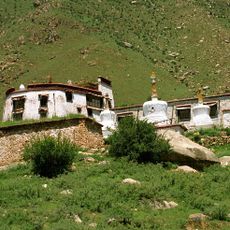
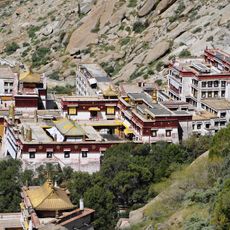
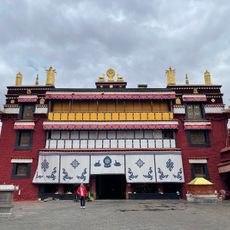
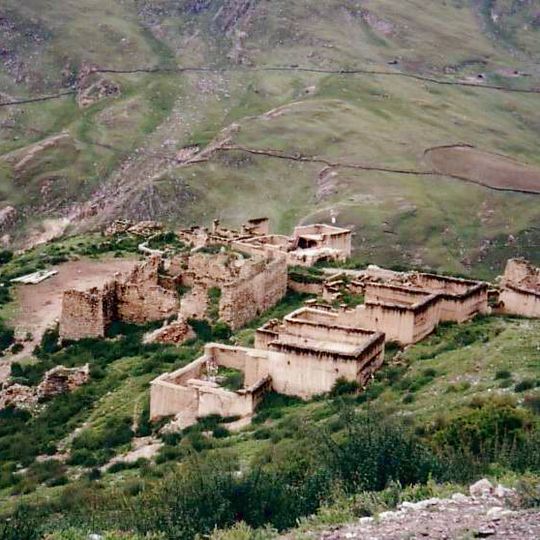
Yerpa (Drak Yerpa) is a monastery and cave complex on a hillside in Dagzê County, about 16 km northeast of Lhasa. Its earthen tan and light brown stone-and-mud buildings with flat roofs stand in staggered tiers on a grassy slope; some are intact, others reduced to wall fragments and rubble. The largest block on the right has a broad flat facade and a projecting lower section, and a taller building rises at the upper center. Small dark openings mark some walls.
Tradition holds that the 7th-century king Songtsen Gampo founded a temple at Yerpa, and his Tibetan queen Monza Triucham established the Dra Yerpa temple. Padmasambhava meditated seven months in the Dawa Puk cave, and after 842 CE the assassin Lhalung Pelgyi Dorje hid in a cave here for 22 years. The Kadampa gompa passed to Gelug control after Je Tsongkhapa's reformation, and the complex was destroyed in 1959 and during the Cultural Revolution.
Pilgrims follow a fixed circuit of caves, beginning at the Tendrel Puk, Atisha's meditation cave, on the left of the climb. The Jampa Lhakhang once held a three-storey Maitreya statue said to be the largest in Ü-Tsang, and the only one in Tibet wearing shoes. A Tibetan proverb holds that the spiritual heart of Tibet is in Lhasa and of Lhasa in Yerpa.
The location is remote and requires careful planning, as visits typically happen through organized tours from Lhasa. The thin air at this elevation can be notable, so it is wise to acclimate yourself beforehand to the conditions.
Tradition holds that Yerpa once had 108 meditation caves, though only about 80 survive, cut at different periods. Pilgrims follow a fixed route past named caves such as the Dawa Puk, where Padmasambhava is said to have meditated for seven months, and the Lhalung Puk, where the assassin of King Langdarma hid for 22 years.
The community of curious travelers
AroundUs brings together thousands of curated places, local tips, and hidden gems, enriched daily by 93,141 contributors worldwide.