Ramoche Temple, Buddhist temple in Lhasa, China
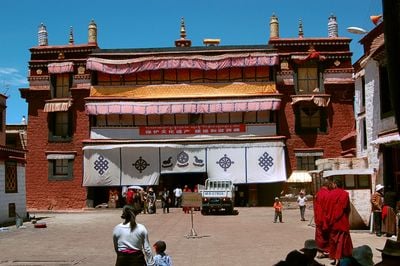
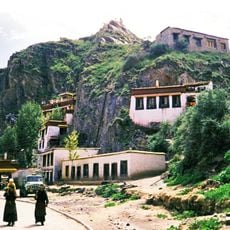
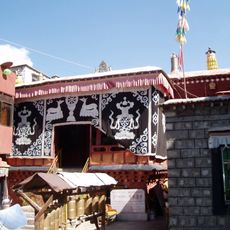
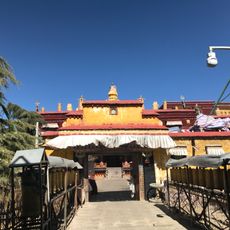
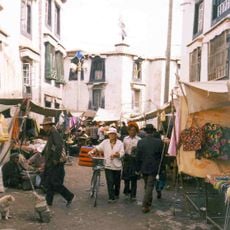
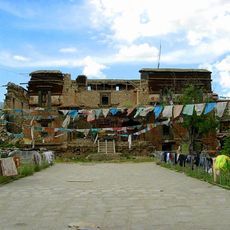
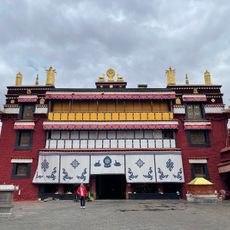
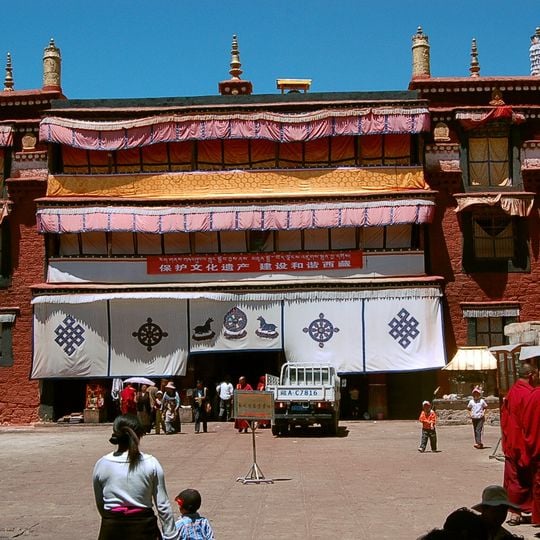
Ramoche Temple is a three-story Buddhist monastery in northwestern Lhasa, covering 4,000 square meters. Its reddish-brown stone facade has a central entrance porch flanked by tower-like sections, tiered horizontally, with pink and orange pleated fabric valances below the roofline. A red banner with white Chinese characters crosses the middle, and a white awning below bears embroidered symbols including a knot, wheel, conch and parasol. Ten pillars near the main entrance display lotus flowers, jewellery, coiling clouds and Tibetan characters.
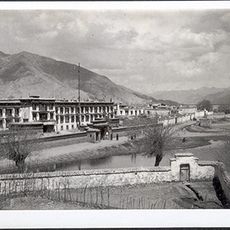
The temple was founded in the 7th century by King Songtsen Gampo, who unified the Tibetan plateau and promoted Buddhism as the religion of his kingdom. It suffered heavy damage during the Cultural Revolution in the 20th century and was later rebuilt, though some sections took decades to restore.
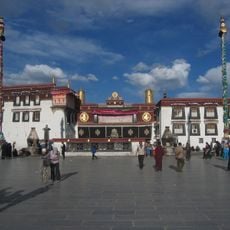
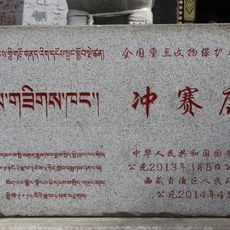
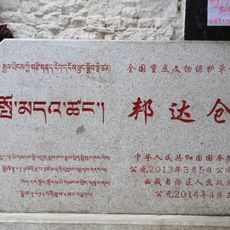
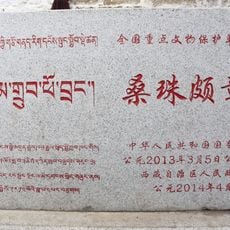
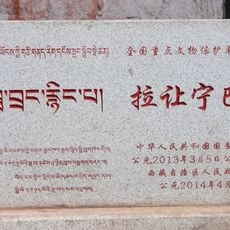
The temple's Tibetan name, Ramoche, and its Chinese name, Xiaozhao, both refer to the Jowo statue: zhao transliterates Tibetan jowo ("lord", i.e. the Buddha image), and xiao ("small") sets it against the Jokhang, the "great" Jowo temple. The name given at its founding, Jiadaremuqi Zulakang, means "Han tiger manifestation temple". The temple is also called Ramoche Gönpa in Tibetan and is known together with the Jokhang as Lhasa's "two Jowo" temples.
Ramoche Temple stands at 49 Remuqi Road in the Jibenggang subdistrict of Chengguan District, about 500 metres north of the Barkhor and roughly 1 kilometre from the Jokhang. The grounds cover about 4,000 square metres. Ten pillars near the main entrance carry carvings of lotus flowers, jewellery, coiling clouds and Tibetan characters. The second floor is mostly residential, and the third-floor quarters are reserved for the Dalai Lama.
The main statue housed here is considered one of the most sacred in Tibet and is believed to show the face of Buddha as he looked during his own lifetime. It was originally brought from Nepal by one of the king's wives, but was later exchanged with a Chinese statue, which today stands in the Jokhang Temple across the city.
The community of curious travelers
AroundUs brings together thousands of curated places, local tips, and hidden gems, enriched daily by 92,885 contributors worldwide.