Liuwu Bridge, Steel arch bridge in Lhasa, China
Liuwu Bridge is a steel arch bridge that spans the Lhasa River and connects downtown Lhasa on the north bank to the southern side of the city. The structure has three lanes in each direction and uses a basket-handle arch design for its framework.
The bridge was completed in 2007 as part of a major regional development project. It plays an important role connecting the city center with new development areas on the south side.
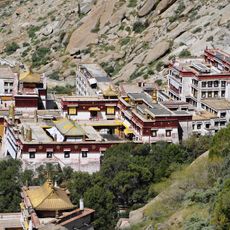
The area around the bridge features residential buildings designed in traditional Tibetan architectural style to maintain local building heritage. You can observe this architecture especially on the south side, where new neighborhoods have developed.
The bridge carries three lanes in each direction and includes Tibet's first cloverleaf junction, so drivers reach Lhasa railway station on the south bank directly from downtown. Pedestrians and cyclists cross alongside the traffic lanes; the 120-metre basket-handle arch rises over the main span. The 1,600-metre crossing is fully paved and lit for use after dark.
The bridge carries Tibet's first cloverleaf junction, and its main span is a duplex basket-handle arch with a 28.4-degree heeling angle and a 120-metre arch length. Its piers rest on piled underground diaphragm walls. It is also the Tibet Autonomous Region's first urban overpass.
The community of curious travelers
AroundUs brings together thousands of curated places, local tips, and hidden gems, enriched daily by 94,156 contributors worldwide.