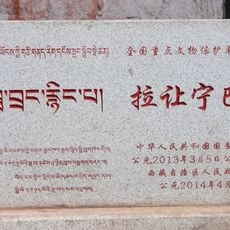
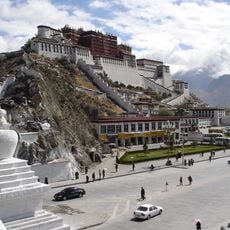
Monument to the Peaceful Liberation of Tibet, Monument at Potala Square in Lhasa, China.
The Monument to the Peaceful Liberation of Tibet is a 37-metre grey-white concrete spire in the southern part of Potala Palace Square in Lhasa, facing the Potala and the national flag at the square's north end. Designed by Qi Kang of Southeast University in Nanjing, it abstractly portrays Mount Everest, with a five-star pattern at its top and a small exhibition hall inside. Its south side carries an inscription in Tibetan and Chinese.
The foundation stone was laid on 18 July 2001 by Vice-President Hu Jintao during the 50th-anniversary celebrations of the 1951 agreement, and the monument was unveiled on 22 May 2002. It was designed by Professor Qi Kang of Southeast University in Nanjing and cost US$1.7 million.
The monument's name is engraved in Jiang Zemin's calligraphy, dated 1 October 2001, and its grey-white body is topped with the five-star motif of the Chinese flag. The 37-metre form abstracts Mount Everest. Inside is an exhibition hall; the south face carries a Tibetan- and Chinese-language inscription dated 18 July 2001.
The monument stands in an open public space and can be reached on foot from most of central Lhasa without difficulty. Military personnel are permanently stationed at its base, so visitors should keep a respectful distance when approaching.
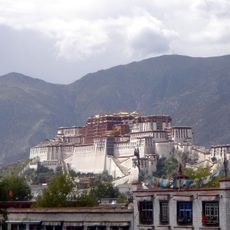
After dark, the spire is lit up, making it one of the few structures on the square that stands out clearly at night. Despite its position on one of Lhasa's most visited open spaces, many visitors spend only a few minutes here before turning their attention to the Potala Palace rising behind it.
The community of curious travelers
AroundUs brings together thousands of curated places, local tips, and hidden gems, enriched daily by 92,787 contributors worldwide.