Tuoshan, Buddhist grottoes and mountain in Qingzhou, China
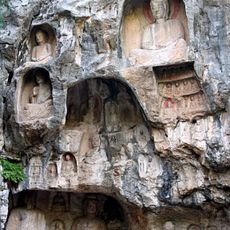
Tuoshan is a mountain featuring 638 stone Buddha statues carved along its eastern edge, with ancient grottoes distributed across multiple levels of the terrain. The caves vary in size and depth, holding carvings of differing detail and style from different periods.
During the Northern Zhou and Tang dynasties, artisans carved Buddhist sculptures into the mountain caves, drawing on diverse artistic influences from Central Asia. This period of intensive stone-carving activity left behind one of China's major centers of Buddhist stone art.
The name Tuoshan means "Camel Mountain", after the shape of its ridge. The 638 carvings in five main grottoes mostly depict the three figures of the Western Paradise: Amitabha, Avalokiteshvara and Mahasthamaprapta, alongside rows of thousand Buddhas, guardian figures, flying apsaras and small donor portraits.
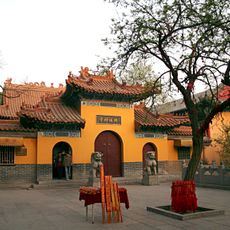
Tuoshan lies about 4 km southwest of Qingzhou's centre. The grottoes run along the mountain's eastern edge near the summit, and the Haotian Temple complex occupies the summit itself, with the Tian Qiao bridge crossing the dry Tian He to reach it. Paths are uneven and steep in places, so wear sturdy footwear.
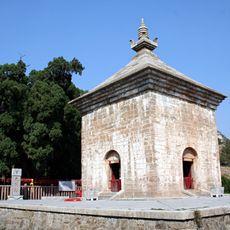
The Qibao Cabinet at Haotian Temple showcases unusual architecture with a double-arched stone structure that requires no supporting beams. This engineering achievement was remarkable for its time and remains a testament to innovative building methods.
The community of curious travelers
AroundUs brings together thousands of curated places, local tips, and hidden gems, enriched daily by 93,459 contributors worldwide.