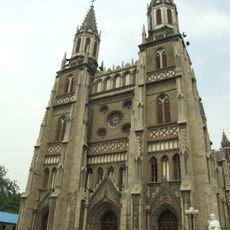
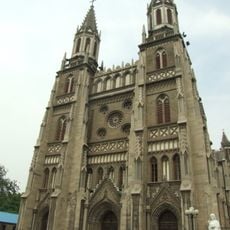
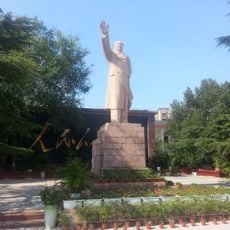
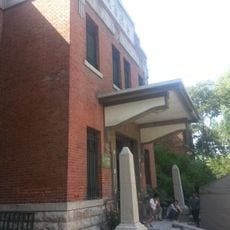
Xingguo Temple, Buddhist temple in Zhangqiu District, China.
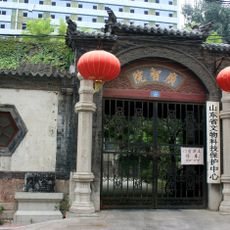
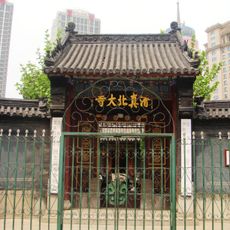
Xingguo Temple is a Buddhist complex on Thousand Buddha Mountain in Jinan, built into the slope with seven halls. Its layout divides into an East Temple, once a mixed Buddhist-Daoist-Confucian courtyard with the Dashun Temple, Wenchang Pavilion and Luban Shrine, and a West Temple, the main part. The gate plaque is inscribed by Zhao Puchu, and the northern Duihua Pavilion sits on a cliff ledge ten metres above the temple.
The temple began in the Kaihuang period (581–600) of the Sui dynasty as the Thousand Buddha Temple, after statues were carved into the cliff. It was renamed Xingguo Chan Temple in the Zhenguan period (627–649) of the Tang. After being ruined in wars, Su Xian raised funds to rebuild it on the original site in 1468, adding the Four Heavenly Kings Hall and Mahavira Hall. It was rebuilt again in the Jiaqing and Xianfeng periods of the Qing.
The temple's name changed from Thousand Buddha Temple to Xingguo Chan Temple during the Tang Zhenguan period. The Shanmen plaque bears characters by Zhao Puchu, and the front pillars carry a couplet by Qing scholar Yang Zhaoqing: "暮鼓晨钟,惊醒世间名利客;经声佛号,唤回苦海梦迷人". The temple is a National Key Buddhist Temple in Han Chinese Area.
The temple is an outdoor complex that can be explored on foot by walking through its various courtyards and halls. Visitors should wear comfortable shoes for walking the grounds and dress respectfully, particularly if any religious ceremonies are taking place.
Across from the main buildings stands a cliff face carved with more than 200 Buddhist stone figures. These sculptures date from the Sui and Tang dynasties and represent a different artistic approach than the temple buildings themselves.
The community of curious travelers
AroundUs brings together thousands of curated places, local tips, and hidden gems, enriched daily by 94,461 contributors worldwide.