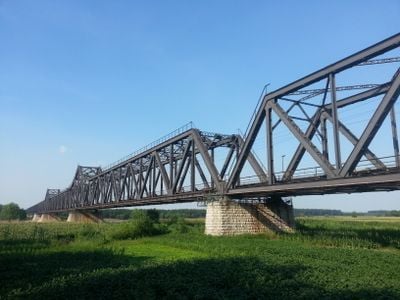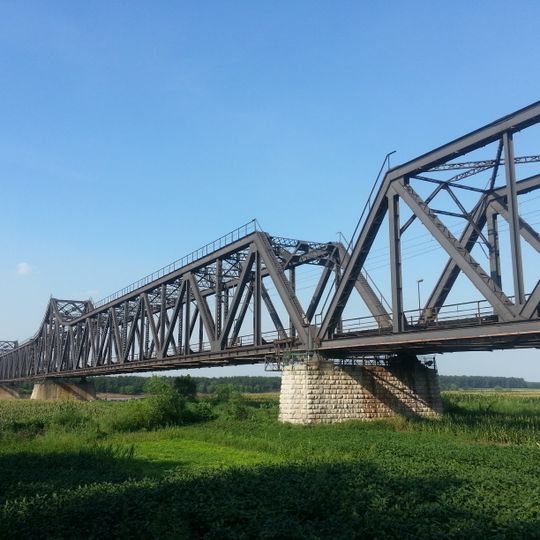
Luokou Yellow River Railway Bridge, Railway bridge in Shizhong District, Jinan, China.
The Luokou Yellow River Railway Bridge is a single-track steel truss bridge 1,225.2 m long, crossing the river and its wide floodplain in twelve spans. The 422.1 m river section is a Gerber beam bridge: a 164.7 m central opening formed by a 109.8 m suspended span between two 27.45 m cantilevers, flanked by two 128.7 m side spans. Concrete piers clad in natural stone carry the 10.8 m wide deck, with the track in the middle and two 1.75 m footpaths behind grilles.
Construction started in October 1909 and was finished in November 1912, with work costing 11.66 million German marks. The bridge became part of the Tianjin-Pukou Railway, one of the earliest major rail routes connecting northern and central China.
Luokou is the name of the village a few hundred metres upstream of the bridge, not a former ferry station. The bridge's completion in 1912 linked the Tianjin–Pukou line end to end, creating a rail route from Beijing to Nanjing and, via the Trans-Siberian, from Europe to central China.
The bridge carries a single working railway track, so it cannot be crossed on foot; the two 1.75 m footpaths beside the track are fenced off and were never opened to the public. View the truss spans from the banks of the Yellow River or from the Luokou area, and keep clear of the track. The bridge is 1,225.2 m long, so the far abutment is distant.
The bridge's reserved double-track design was never realised: after 1958 planners judged the piers too weak for two lines and built the double-track Caojiaquan bridge upstream instead, keeping Luokou single-track. In 1992, for flood-control reasons, the steel girders of spans 1 to 4 were removed.
The community of curious travelers
AroundUs brings together thousands of curated places, local tips, and hidden gems, enriched daily by 94,465 contributors worldwide.