Black Tiger Spring, Artesian karst spring in Jinan, China.
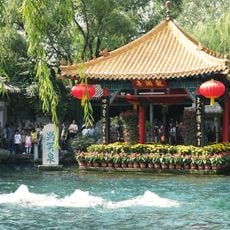
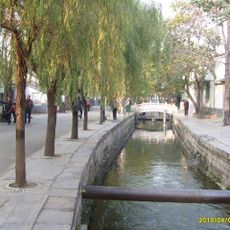
Black Tiger Spring is an underground karst formation in limestone from which water flows through three stone-carved tiger heads into a square pool below. The water connects to an ancient canal that winds through the old city.
Black Tiger Spring appears in the Jin-dynasty Name-Spring Stele and in Ming-dynasty poems by Yan Bi and Yan Bizeng. A Black Tiger Temple stood above the cave in the Jiajing era; when it collapsed, the Qing rebuilding replaced it with stone tiger heads. The pool was enlarged in August 1931 and given three tiger-head spouts, and pavilions were added in 1985.
The name comes from a moss-covered black rock once lying in the cave, said to resemble a crouching tiger, while the gushing water sounded like a roar. The Ming poet Yan Bizeng described the spring's old layout in verse. A Black Tiger Temple stood above the cave in the Jiajing era (1522–1566) before falling into ruin; when the stone pool was rebuilt in the Qing dynasty, carved tiger heads replaced it as the water outlet.
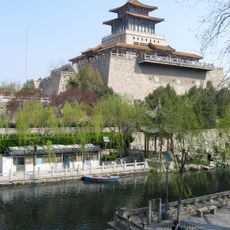
The spring sits on the south bank of the old city moat at its southeastern corner, with Liberation Pavilion on the opposite bank to the east. The pool is fed from a cave opening 2 m high, 1.5 m wide and 3 m deep, and the water leaves through a sluice on the pool's north bank into the moat. The spring's flow is a gauge of Jinan's groundwater level, so it swells after rain and thins in dry spells.
The spring's flow is watched as a gauge of Jinan's groundwater: it ranks second only to Baotu Spring in volume, and its surging or faltering mirrors the city's water table. The pool sits at an elevation of 27.88 metres, and the water leaves the cave mouth through an opening 2 metres high, 1.5 wide and 3 deep.
The community of curious travelers
AroundUs brings together thousands of curated places, local tips, and hidden gems, enriched daily by 93,807 contributors worldwide.