Four Gates Pagoda, Stone pagoda in Licheng District, China
The Four Gates Pagoda is a stone structure with four identical openings facing the cardinal directions, supported internally by a central pillar with triangular beams. The building stands approximately 10 meters tall and has preserved its original form and construction techniques.
A stone tablet found inside the roof in 1972 records construction in the seventh year of the Daye period, 611 AD. The four Buddha statues carry a 544 AD dedication by official Yang Xianzhou, so they predate the pagoda. The site was listed as a Major Historical and Cultural Site Protected at the National Level in 1961. The head of the Akshobhya Buddha was stolen in 1997 and returned in 2002.
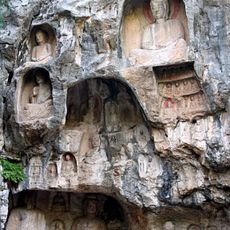
The pagoda's name comes from its four arched doors, one in the centre of each wall, facing the cardinal directions. Inside, a square central pillar carries a seated Buddha on each face: Subtle-voiced Buddha to the north, Ratnasambhava to the south, Akshobhya to the east and Amitabha to the west. An inscription on the statue bases records that the official Yang Xianzhou commissioned them in 544 AD, in memory of his ancestors, on the anniversary of his father's death.
The site sits at the base of Qinglong Mountain, accessible to those visiting the area around Jinan, and allows time to walk around all four sides and view the interior layout. Daytime visits provide better visibility for observing the stonework and surrounding features, including the ancient tree nearby.
The Nine-tip Pine (jiu ding song), also called the Thousand Year Pine, grows beside the pagoda and is believed to be over a thousand years old. Two Tang dynasty pagodas, the Dragon-and-Tiger Pagoda and the Minor Dragon-and-Tiger Pagoda, stand nearby.
The community of curious travelers
AroundUs brings together thousands of curated places, local tips, and hidden gems, enriched daily by 92,781 contributors worldwide.