Pizhi Pagoda, Buddhist pagoda in Changqing, China
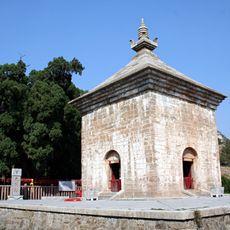
The Pizhi Pagoda is an octagonal, nine-story brick-and-stone tower rising 54 m at Lingyan Temple in Changqing, near Jinan. Its carved stone facade sits on a pedestal sculpted on four sides with scenes of the Buddhist afterlife and of torture in Hell. Balconies on dougong brackets support the first three stories; the fourth through ninth have only pent roofs. An iron steeple of inverted bowl, discs, sun, crescent and bead crowns the top.
The current structure was built between 1056 and 1063 during the Song Dynasty to replace an earlier tower erected in 753. This rebuilding shows how important this religious site remained for the region across centuries.
The name Pizhi translates the Sanskrit pratyeka, a buddha who reaches enlightenment alone after Sakyamuni's death, without teachers or a monastic community. The Song builders dedicated the pagoda to these self-taught figures, a rare theme among Chinese pagodas. Visitors can see this today in the carved stone pedestal, whose four sides show scenes of the Buddhist afterlife and hell tortures.
Inside, a large brick pillar and a brick stairway lead only as far as the fifth floor. To reach the top and the iron steeple, you must use the winding staircase outside the pagoda. This external route is rare in brick pagodas, though common in stone ones.
The iron steeple is held in place by chains anchored to small iron statues of celestial guards on the corner ridges. This arrangement, meant to keep the steeple firm, is rarely seen in brick pagodas, where such external stair and chain systems are uncommon.
The community of curious travelers
AroundUs brings together thousands of curated places, local tips, and hidden gems, enriched daily by 93,069 contributors worldwide.