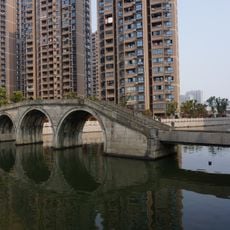
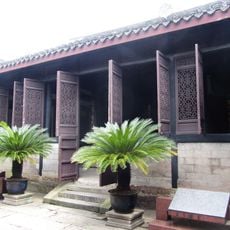
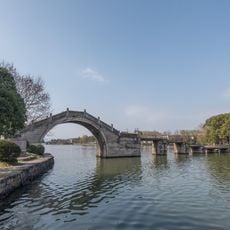
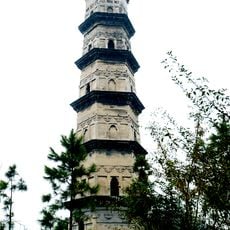
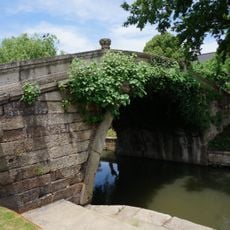
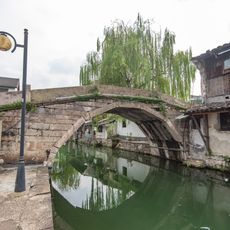
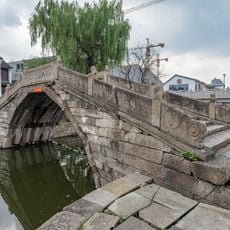
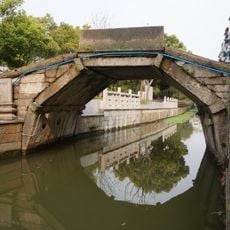
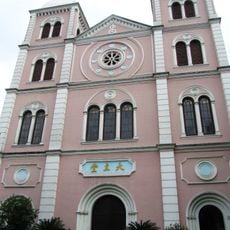
Yu the Great mausoleum, National cultural monument in Kuaiji Mountain, China.
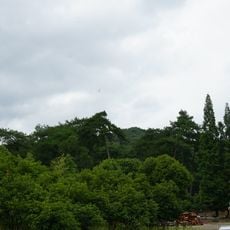
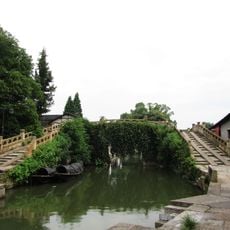
The Yu the Great mausoleum stands at the foot of Mount Kuaiji in Yuling village, 8 km southeast of Shaoxing, with the tomb facing west. In front lies the Yu pond, facing Ting hill; a stele pavilion holds a stone inscribed "Yu the Great mausoleum". Northeast of the tomb, the south-facing Yu temple is a palace-style complex of three halls: Meridian Gate, sacrificial hall and main hall.
Yu the Great's son Qi founded a shrine here after his father was buried on Mount Kuaiji, with sacrifices held each spring and autumn. The Yu Temple northeast of the tomb was first built in the early Liang dynasty; its main offering hall, first built under the Jiajing emperor, was rebuilt between 2007 and 2008. The site was badly damaged during the Cultural Revolution, and repairs began in 1976.
The site draws people from across China who come to honor Yu the Great, a figure long seen as the one who tamed the ancient floods and made the land livable. Visitors often burn incense at the temple, and the walls inside carry inscribed texts praising his dedication to the people.
The complex lies a few kilometers southeast of central Shaoxing, and reaching the different buildings requires a fair amount of walking across the hillside. The paths include stairs and slopes that can get slippery after rain, so sturdy footwear is a good idea.
The stele inside the Yu temple, the Kelou stele, bears 77 characters shaped like tadpoles, unlike the oracle bone or bronze script of Yu's era. Some scholars therefore doubt it is Yu's stele and argue the real tomb lies in the flood-prone Yellow River basin, not at Shaoxing. East of the temple, the Yaoshi pavilion holds a 2-metre conical stone pierced by a round hole.
The community of curious travelers
AroundUs brings together thousands of curated places, local tips, and hidden gems, enriched daily by 93,624 contributors worldwide.